
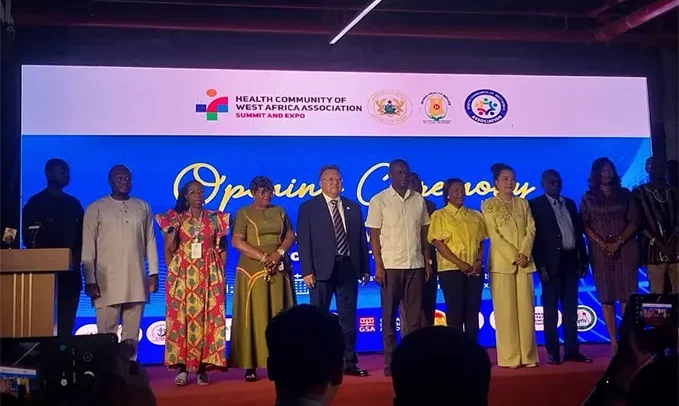
Dignitaries at the summit
The government has called for local production of medical technologies in the country to help reduce the importation of finished medical products as well as improve the country’s healthcare system.
Speaking at the Third China-West African Medical Expo and AI Diagnostic Summit in Accra, the Deputy Minister for Health, Dr. Grace Ayensu-Danquah, disclosed that Ghana’s growing healthcare needs require partnerships that deliver long-term capacity rather than dependence on imported technologies.
She added that Ghana’s cooperation with China should focus on local manufacturing and assembly, technology transfer, research collaboration, professional training and investment in technical capacity, noting that such investments would strengthen the country ‘s health security, create jobs and contribute to a strong healthcare system.
“Our partnership should go beyond importing finished products to include local manufacturing and assembly, technology transfer, research collaboration, professional training, and investment in Ghana’s technical capacity,” she stressed.
Dr. Ayensu-Danquah further urged stakeholders to ensure that the use of artificial intelligence (AI) in healthcare is safe, affordable and suitable to the country’s health system, stressing that AI-assisted diagnostics, medical imaging, predictive analysis and digital health systems could help address shortages in specialist expertise, especially at the primary healthcare level.
She pointed out that technology must complement healthcare professionals rather than replace them. “Technology must support, not replace, the judgment and human connection of health professionals,” she stated.
Also, the Deputy Director of Ghana Health Service, Dr. Caroline Reindorf Amissah, called for the responsible implementation of artificial intelligence to strengthen healthcare delivery across Ghana and West Africa, stating that AI is becoming part of healthcare.
She added that the success of AI in healthcare should not be judged by sophistication of the technology but by its ability to help health professionals to make better decisions, detect diseases earlier, as well as improve the outcomes of patients.
Dr. Amissah further urged technology developers and investors to prioritise practical and locally appropriate solutions capable of addressing the continent’s healthcare challenges, and encouraged stronger collaboration between African institutions, Chinese technology and healthcare organisations, particularly in knowledge transfer, research, professional development, capacity building and local innovation.
The President of Health Community of West Africa Association (HCOWAA), Madam Sihong Jian, stated that HCOWAA aims to help make Ghana the centre for healthcare transformation in West Africa, stressing that the country has the potential to become the leading health hub in the region.
By Florence Asamoah Adom