
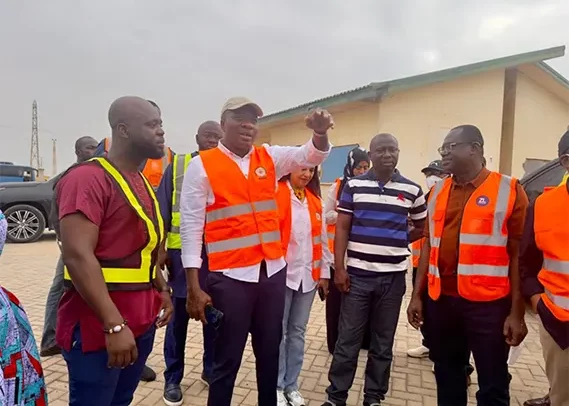
Mahama Ayariga interacting with officials of Kpone Landfill site
The government is set to enforce the “polluter pays” principle as part of measures to address the nation’s worsening waste management challenges, Minister for Local Government, Chieftaincy and Religious Affairs, Mahama Ayariga, has announced.
Under the proposed approach, households, property owners, businesses, factories and other establishments that generate waste will be required to pay their fair share of the cost of collecting, transporting and treating the waste.
Mr. Ayariga said the government could no longer continue to rely on public resources to subsidise waste generated by individuals and businesses, particularly in major cities.
He said the situation required a fundamental overhaul of the country’s waste management system, beginning with waste separation at the household level and extending to collection, transportation, transfer stations, treatment and composting.
The Minister made the remarks after an early-morning inspection of waste management facilities in Accra with officials of his ministry and prospective development partners.
Some of the facilities visited are the Lavender Hill Faecal Treatment Plant at Korle-Bu, Achimota Waste Transfer site, Kpone Landfill Decommissioning project site, and the Accra Compost and Recycling Plant at Adjen Kotoku.
According to him, the inspection had exposed significant gaps in the existing system for collecting and managing waste from homes and other sources.
“We must put in place a system for separating it right from the homes,” he said, adding that households must also be provided with appropriate receptacles to facilitate the collection and transportation of waste.
Mr. Ayariga said transfer stations must be brought closer to communities, while treatment and composting facilities should also be located closer to major urban centres to reduce the distances travelled by waste trucks.
He explained that the long distances currently travelled by waste collection vehicles significantly increased the cost of waste management through fuel consumption, vehicle wear and tear and other operational expenses.
He, therefore, expressed confidence that a more efficient system could reduce the cost of waste management for households by as much as 50 percent.
The Minister also warned property owners and businesses against expecting the government to bear the entire cost of managing the waste generated by their activities.
He said the physical presence of factories, businesses and other establishments in urban areas attracted workers and residents, thereby contributing to the generation of waste in those communities.
“If you are living in Accra, pay for your waste in Accra. If you have a factory here and the factory is generating waste, the factory owner and the profit that you are making, it will be unfair for you not to be held accountable for the waste that is generated,” he stated.
Mr. Ayariga further argued that the Common Fund should not be used to finance waste generated by residents and businesses in Accra at the expense of other parts of the country.
He said residents were expected to pay their basic rates and property owners their property rates, while other applicable levies should also be collected by the Metropolitan, Municipal and District Assemblies.
“If we collected the basic rates that everybody is supposed to pay, the property rates that everybody is supposed to pay, the market rates and all the rates that everybody is supposed to pay to the city authorities, I am very confident that problems like this will not be beyond our capacity,” he said.
The Minister, however, acknowledged that the responsibility could not rest solely on citizens.
He said assemblies must make it easier for residents to pay the required rates and, in turn, must account for the resources collected by investing them in essential services.
He listed waste management, street lighting, roads, greening, security and other basic amenities among the services that residents should expect from their assemblies.
Mr. Ayariga also pledged that government would be accountable, efficient and transparent in the management of resources collected from residents.
He said the government was exploring financing opportunities with development partners and other prospective partners to mobilise resources for investment across the entire waste management chain.
The Minister disclosed that the government was also examining the potential for generating gas from waste sites for possible commercial use.
He said technical assessments would be required to determine the quantity of gas available, how long it could be extracted and whether the potential returns would justify the investment.
Mr. Ayariga described the current state of some waste facilities as a threat to public health, and said the government was determined to address the problem.
He said the challenges observed in Accra were representative of problems confronting other major cities across the country, including Kumasi and Takoradi.
“This will serve as the basis for planning and taking investment,” he said.
The Minister also announced plans for a broader campaign against poor sanitation and what he described as indiscipline in the management of waste.
He said his tenure would not be driven by a desire for popularity but by a determination to enforce the rules governing sanitation and local government.
“I am not engaged in a popularity contest. I don’t want to be popular. If I get popular, I want to be popular for making sure that everybody is uncomfortable doing the wrong things,” he said.
Mr. Ayariga appealed to residents, businesses, local government authorities, development partners and the media to support the government’s efforts to reform waste management.
He said while residents must be prepared to pay for the services they consume, assemblies and government agencies must also be prepared to account for the resources entrusted to them.
“When we start exacting our pound of flesh from every resident of this city, a lot of people will complain. We need you to support us. But at the same time, if we also take the resources and we don’t invest it in the neighbourhoods and in the welfare of the people, we demand that you also hold us accountable for not doing the right thing,” he said.
By Ernest Kofi Adu