
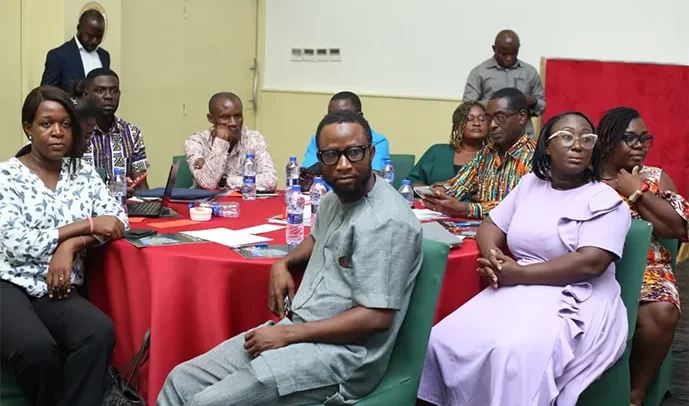
Participants present at the workshop
The Ghana Statistical Service (GSS) hosted a workshop yesterday to advance a national framework for measuring inclusive and sustainable growth beyond Gross Domestic Product (GDP).
The forum brought together policymakers, researchers, development partners, academia, and civil society to deliberate on indicators that capture social progress, environmental sustainability, equity, and well-being alongside traditional economic measures.
Acting Deputy Government Statistician for Economic Statistics and Data Science, Francis Bright Mensah, said GDP remains “an indispensable tool” for tracking production and anchoring policy, but it does not reflect broader dimensions of development that matter to citizens.”
“A rising GDP may signal economic growth, but if that growth comes with deforestation, land degradation, water pollution, biodiversity loss, or widening inequality, then the picture of progress is incomplete,” Mensah said.
He stressed that the ‘Beyond GDP’ agenda is not to abandon or replace GDP, but to complement it with measures of national wealth including people, natural resources, institutions, and communities.
“It seeks to ensure that the growth we pursue today does not compromise the opportunities available to future generations,” he added.
Mensah said GSS has already begun work on the agenda through environmental statistics, Sustainable Development Goal indicators, multidimensional poverty measurement, and the System of Environmental-Economic Accounting.
“The real question is: How do we develop a framework that is distinctly Ghanaian? One that reflects our national values and development aspirations, speaks to our environmental realities and cultural heritage, and captures what Ghanaians themselves consider to be prosperity, dignity, and a good life,” he quizzed.
Senior Lecturer at the University of Ghana’s Department of Economics, Dr. Adu Owusu Sakordie, said GDP captures only quantitative indicators. “To go beyond the numbers, we need to look at the quality of development,” he said.
He noted that Ghana’s GDP is driven by four main contributors: household consumption accounts for more than 80%, private and public investment about 18%, government consumption expenditure about 80%, and net exports. Going beyond those contributors requires assessing access to electricity, social capital, quality of life, roads, and employment, Sakordie said. The approach helps government and policymakers “look beyond the numbers and truly assess the quality of life.” He added that Ghana ranks second to Cape Verde in West Africa on many of those development indicators.
Professor at the Department of Environmental Sciences and Policy, Central European University, Dr. Lázló Pintér, said the International Institute for Sustainable Development is supporting national partners like Ghana to apply ‘Beyond GDP’ concepts locally.
“Beyond GDP is not a single indicator but a wider range of metrics designed to complement GDP with factors it omits, such as unpaid household work and the condition of natural ecosystems,” Pintér said.
He said success for Ghana in ten years would mean “a significantly reduced risk of ignoring the social and environmental dimensions of development.”
“By utilising a more wholesome metric, policymakers can avoid paths that create high environmental costs, social inequity, or vulnerability, ultimately leading to more robust and resilient national policies,” he added. Globally, countries and international organisations are advancing ‘Beyond GDP’ approaches that pair economic measures with indicators of inclusion, resilience, and quality of life.