
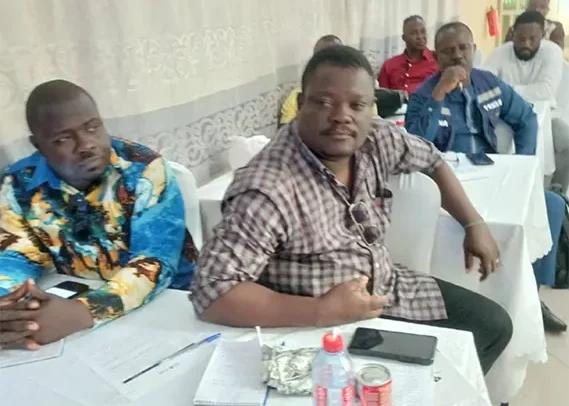
A scene during the training
A NUMBER of journalists in Bono and Bono East regions have been trained on issues affecting reproductive health rights of girls in the various communities.
Organised by Alliance for Reproductive Health Rights (ARHR), a non-governmental organisation (NGO), the engagement was part of activities to promote healthy reproductive health among Ghanaian women and girls.
The journalists were taken through statistics that showed worrying trend of increasing teenage pregnancy among female junior high school (JHS) and senior high school (SHS) students. They discussed sexual-based violence against women and girls as well as effects of sexually transmitted diseases (STDs) such as HIV and AIDS.
Isaac Nyampong, Programme Manager of ARHR, said non-access to vital information for adolescent girls compel them to take decisions that negatively affect their stay in school.
He, therefore, called on media practitioners to discuss health reproductive issues on their programmes as well as educate women and girls on their basic rights regarding family planning services, risky behaviours such as unprotected sex and others.
He further entreated media practitioners to encourage parents to discuss age-specific sex education with their children, to avoid adolescent pregnancy and STDs.
Mr. Nyampong pointed out that lack of information put adolescent girls at risk as well as damage their future. Using statistics to buttress his point, he said data from Education Management Information System from 2021 to 2022 showed 909 primary girls became pregnant, while 5,119 JHS girls were also pregnant, with 2,512 SHS girls pregnant during 2021.
8,540 girls also dropped out of school because of unwanted pregnancies. Again, in 2022, 1,753 pregnancies were recorded at the primary schools, 4,259 at the JHS, and 464 at the SHS, bringing to a total of 6,476 girls who through no fault of theirs or out of ignorance dropped out from school.
On his part, Benjamin Oppong -Twumasi, Programme Manager- Policy and Budget Advocacy, ARHR, explained that the training aims to use the media to highlight the issues militating against women and girls in the country.
According to him, failing to plan families, child marriage, teenage pregnancy, violence against women and other social vices work against development.
The media practitioners, at the end of the training, appreciated the efforts and promised to put into practice what they were taught.
FROM Daniel Y. Dayee, Techiman