
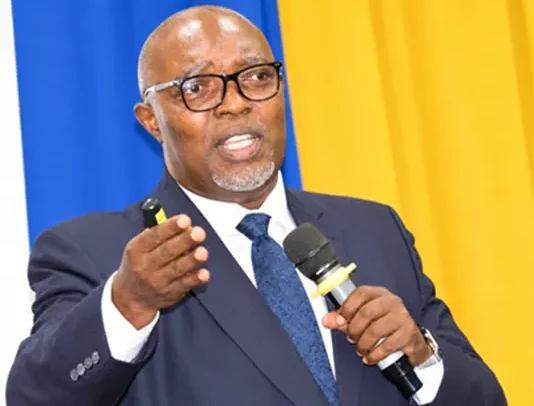
Prof. Robert Darko Osei
Government’s ability to sustain economic growth and finance critical development projects is being constrained by low domestic revenue mobilisation, the Institute of Statistical, Social and Economic Research (ISSER) has warned.
According to the institute, the country’s tax revenue remains below the sub-Saharan African average, limiting the Government’s capacity to fund infrastructure, create jobs and support economic diversification without resorting to spending cuts.
The warning was contained in ISSER’s State of the Ghanaian Economy Report 2025, launched amid efforts by the Government to consolidate economic gains and accelerate growth.
Presenting the report, the Director of ISSER, Professor Robert Darko Osei, said the nation’s tax revenue stood at about 30 percent of Gross Domestic Product (GDP) in 2025, significantly below the sub-Saharan African average.
“Our revenue effort is a bit low. In fact, tax revenue is under 30% in 2025, was about 30% of GDP, and that was significantly lower than that which pertains in sub-Saharan Africa,” he stressed.
Professor Osei said the country needed to broaden its tax base by bringing more individuals and businesses into the tax net rather than increasing the burden on existing taxpayers.
“What it then points to is the need for bringing more into the tax net as it were, so that the revenue effort can be improved,” he said.
He said a broader tax base would strengthen domestic revenue mobilisation and help the government generate the resources required to support its development priorities.
Professor Osei also cautioned that the planned economic rebasing could reduce the tax-to-GDP ratio if revenue collection failed to grow alongside the measured size of the economy.
He explained that economic rebasing involves updating the base year and data used to calculate national economic indicators, and added that although it can provide a more accurate picture of the size and structure of an economy, it can also change the relationship between tax revenue and GDP.
The ISSER director further observed that the nation’s improved fiscal position in 2025 was driven largely by expenditure reductions rather than a significant increase in revenue or grants relative to GDP.
He said revenue and grants remained broadly unchanged as a proportion of GDP, suggesting that spending restraint accounted for much of the improvement in the country’s fiscal position.
The findings raise questions about the sustainability of fiscal gains if the government cannot mobilise additional revenue to meet growing demands for public investment and essential services.
Professor Osei said the government needed to reconsider its spending priorities while intensifying efforts to raise more revenue domestically.
He also pointed to the average tariff rates, which he said were higher than those of neighbouring countries, as another reason to strengthen the domestic tax base rather than rely heavily on existing revenue sources.
By Ernest Kofi Adu