
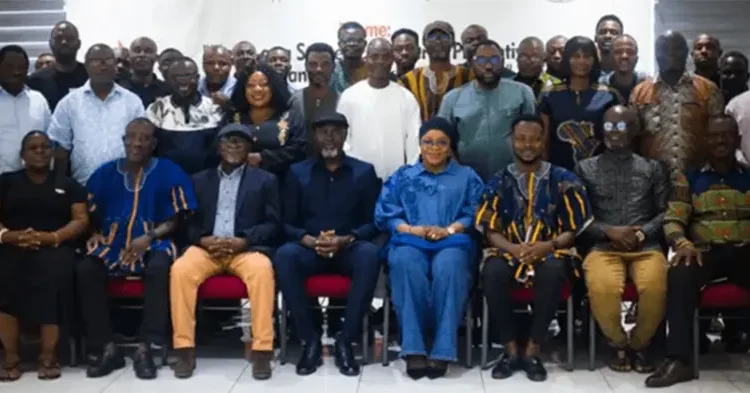
Shamima Muslim (M), COP Abdul-Osman Razak and participants
The media has been urged to uphold information integrity through responsible reporting, to help prevent misinformation which has the tendency to deepen social divisions as well as create conditions that threaten security and stability of the country.
Deputy Presidential Spokesperson, Shamima Muslim, made the call when she represented the Minister of State in charge of Government Communications, Felix Kwakye Ofosu, at a capacity-building workshop on responsible security reporting organised by the Private Newspapers and Online News Publishers Association of Ghana (PRINPAG) in Accra.
She warned that failure to maintain information integrity could amplify existing challenges in society and expose the country to security threats experienced in some parts of the Sahel region.
“When we fail on information integrity, we amplify our internal fault lines, Northerners versus Southerners, Christians versus Muslims, electoral commission versus political parties. And then we invite the Sahel home,” she stated.
Ms. Muslim noted that a pattern had emerged in countries such as Burkina Faso, Mali and Niger, where information manipulation was used to weaken public trust in institutions.
“In the Sahel, the playbook is clear. First, flag social media with government footholds. Then discredit traditional media as elite and disconnect them from reality. Then present the uniform as the saviour. When we rise above our narrow interests, journalism and politics defend democracy and protect the public good,” she stated.
Ms. Muslim said Ghana’s security environment required stronger collaboration between the media and state institutions, particularly as the country operated in a region facing terrorism threats, internal tensions and an information war that moved faster than conventional conflicts.
The Deputy Government Spokesperson said the relationship between the media and politics had historically contributed to the protection of democracy, citing the role of journalists in advocating for constitutional rule, the passage of the Right to Information Act, and exposing corruption through investigative journalism.
She, however, expressed concern about challenges confronting the print media, including technological disruption, declining advertising revenue and a credibility crisis caused by the spread of unverified information.
She observed that while print media circulation had declined significantly over the years, its role as a credible source of records, context and historical documentation remained critical.
“Radio is fast. Television is dramatic. Online is viral. Print is record. Print is what resides in courts, in handouts and in history books. If print loses relevance, we lose our national memory,” she said.
She, therefore, stressed that accurate reporting was particularly important during security crises, as careless headlines and unverified claims could damage public confidence and fuel tensions.
Ms. Muslim also urged authorities to also improve communication by providing timely and accurate information to prevent speculation, as accurate official information, if delayed, will rightly fill the vacuum, adding that where operational details cannot immediately be disclosed, authorities should explain those limitations honestly and provide verified updates as circumstances permit.
The workshop, held under the theme “Media as a Strategic Partner in Preventive and Early Warning in Ghana,” brought together stakeholders including the National Security Coordinator, COP Abdul-Osman Razak, and the Director-General of the Cyber Security Authority, Divine Selase Agbeti.
By Ebenezer K. Amponsah