
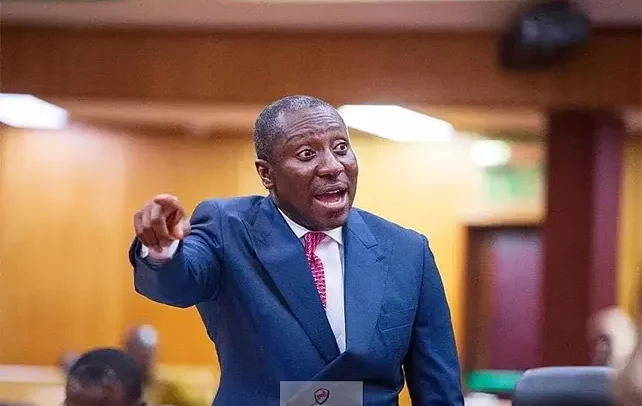
Alexander Afenyo-Markin
The Minority in Parliament has called for the establishment of a parliamentary committee to investigate the government’s preparedness for the recent floods in Accra, insisting that statements of regret and emergency relief alone are insufficient to address a “preventable national disaster.”
Addressing a press conference in Parliament yesterday, the Minority Leader, Alexander Afenyo-Markin, said the proposed inquiry should examine the conduct of the government’s Anti-Flood Task Force and all relevant ministries and agencies responsible for flood preparedness.
According to him, the investigation should establish what work, if any, the task force carried out since its establishment, the amount of public funds allocated to it and how those resources were utilised, the mitigation measures implemented ahead of the rainy season, and why those interventions failed to prevent or significantly reduce the impact of the flooding.
He further demanded that any public officials found to have been negligent or to have failed in their duties be held accountable.
Pending the outcome of the inquiry, Mr. Afenyo-Markin called for members of the Anti-Flood Task Force to step aside to allow investigations to proceed without interference.
“This is not a presumption of guilt,” he said and added, “It is a basic standard of accountability that any institution facing serious questions over its conduct should observe.”
The Minority Leader blamed the devastating floods on what he described as government negligence rather than an unavoidable natural disaster, arguing that the flooding exposed the failure of an Anti-Flood Task Force established by President John Dramani Mahama last year to prepare the capital for the rainy season.
He recalled that the task force, chaired by the Deputy Chief of Staff in charge of Operations, Stanislav Xoese Dogbe, was established with assurances that lessons from previous floods had been learnt and that effective interventions would be undertaken before the onset of the rains.
However, Mr. Afenyo-Markin said Monday’s floods demonstrated that no meaningful preventive work had been carried out.
“If serious drainage works and flood mitigation infrastructure had been undertaken, the impact of the rains, however heavy, would have been measurably reduced,” he stated.
The Minority Leader also criticised the government’s sanitation policy, arguing that the decision not to renew major waste management contracts without putting credible alternatives in place had contributed to clogged drains and worsening floods.
“A government cannot dismantle a sanitation system without securing its replacement, then act surprised when the resulting refuse chokes the city’s drains,” he said.
Responding to government explanations that the exceptional volume of rainfall contributed to the flooding, Mr. Afenyo-Markin argued that the existence of seasonal weather forecasts made preparedness even more imperative.
He maintained that the President could not simultaneously acknowledge that human activities such as building on waterways contributed to flooding while absolving the government of responsibility for failing to address those known risks before the rains.
The Minority Leader also linked the flooding to the government’s handling of illegal mining, claiming that continued galamsey activities had degraded watersheds, wetlands and river systems that naturally absorb and channel excess rainfall.
He accused the government of failing to honour its campaign promises to eradicate illegal mining and further alleged that the operations of the Ghana Gold Board had created incentives that indirectly sustained illegal mining activities.
While welcoming the government’s decision to allocate GH¢350 million for flood relief and mitigation, Mr. Afenyo-Markin insisted that Parliament must receive detailed, itemised reports on how the funds would be disbursed.
He called for a regional breakdown of the expenditure, stressing that flood-hit communities outside Greater Accra should receive equitable support.
The Minority also demanded an urgent briefing from the Minister for Health on measures being implemented to prevent outbreaks of cholera, typhoid and other waterborne diseases in flood-affected communities.
Mr. Afenyo-Markin expressed sympathy to families who had lost relatives and property in the disaster and pledged that the Minority would use every constitutional means available to ensure that those responsible for any lapses in flood preparedness were held accountable.
By Ernest Kofi Adu, Parliament House