
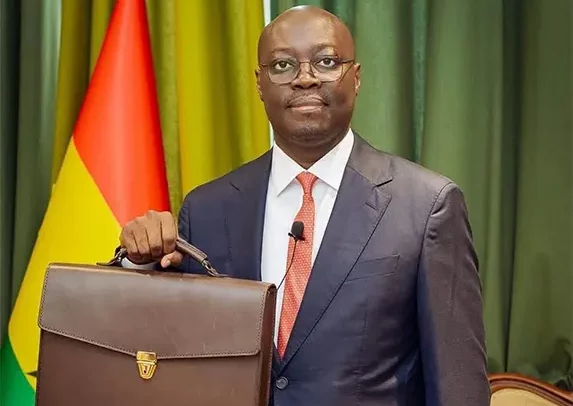
Dr. Cassiel Ato Forson
The Government has ruled out presenting a supplementary budget for the 2026 financial year, asserting that it will maintain the spending ceiling approved by Parliament despite changing economic and development priorities.
Presenting the 2026 Mid-Year Fiscal Policy Review to Parliament yesterday, the Finance Minister, Dr. Cassiel Ato Forson, announced that the government would not seek additional appropriations but would instead undertake a strategic realignment of expenditure within the existing budget.
“Today, I am not here to seek a supplementary estimate. The 2026 appropriations remain unchanged,” Dr. Forson told the House, adding that the government would continue to finance its programmes by reprioritising expenditure rather than increasing the overall budget envelope.
The announcement means Parliament will not be asked to approve additional spending for the current fiscal year, a move often made through supplementary estimates when governments require extra resources beyond the original budget.
According to the Finance Minister, the decision reflects the administration’s commitment to fiscal discipline and prudent public financial management while ensuring that priority programmes continue to receive funding.
Instead of expanding expenditure, he explained that the government would strategically reallocate resources within the approved appropriations to respond to emerging national priorities without breaching the fiscal framework approved by Parliament.
The Minister reaffirmed the government’s key macroeconomic targets for 2026, maintaining projections of at least 4.8 percent real Gross Domestic Product (GDP) growth, 4.9 percent non-oil GDP growth, end-year inflation of 8±2 percent, a primary surplus of 1.5 percent of GDP on a commitment basis, and gross international reserves sufficient to cover not less than three months of imports.
Dr. Forson indicated that economic performance during the first half of the year suggests that these targets are not only achievable but are already being exceeded in several areas.
He disclosed that the country’s economy expanded by 6.4 percent during the first quarter of 2026, significantly above the full-year growth target, while non-oil GDP growth reached 6.3 percent, underscoring broad-based economic recovery beyond the extractive sector.
Inflation, which the government has identified as a key indicator of economic stability, also recorded significant improvement.
According to the Minister, the inflation rate declined from 13.7 percent in June 2025 to 5.3 percent by the end of June 2026, which he indicated, is comfortably below the government’s projected year-end range.
He stated that fiscal performance also remained stronger than programmed during the review period.
The Finance Minister told Parliament that the primary fiscal balance recorded a surplus of 0.9 percent of GDP on a commitment basis by the end of June, placing the country firmly on course to achieve its end-year target of a 1.5 percent surplus.
He said the Gross International Reserves also exceeded expectations, rising to the equivalent of five months of import cover compared to the government’s minimum target of three months.
On expenditure management, Dr. Forson said total spending on a commitment basis stood at 8.0 percent of GDP at the end of June against a half-year target of 9.9 percent.
Primary expenditure, which excludes interest payments, reached 6.6 percent of GDP compared to the programmed target of 8.1 percent, while interest costs remained below expectations due to lower borrowing costs and improved debt management, he added.
He attributed the “stronger-than-expected fiscal performance” to strict expenditure controls and the government’s commitment to its fiscal consolidation programme.
“The provisional fiscal outturn for the first half of 2026 was stronger than anticipated, indicating continued prudence in fiscal management and adherence to Government’s fiscal consolidation agenda,” he said.
Dr. Forson stressed that the government remains committed to strengthening domestic revenue mobilisation without imposing additional tax burdens on households and businesses.
He said efforts to increase non-oil tax revenue would continue to focus on improved tax compliance, wider tax coverage and enhanced revenue administration supported by technology rather than introducing new taxes or increasing existing tax rates.
By Ernest Kofi Adu, Parliament House