
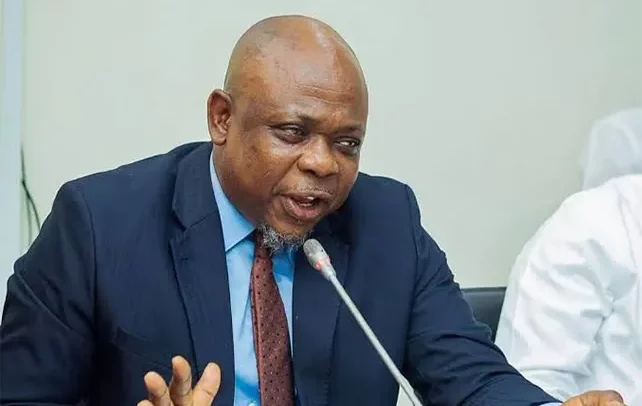
James Agalga
The Majority Leader, James Agalga, has challenged the opposition New Patriotic Party (NPP) to a debate on drug trafficking, insisting that the party cannot match the National Democratic Congress (NDC) government’s record in combating the narcotics trade.
He accused the NPP of politicising the issue and recalled several drug-related seizures and arrests during its time in government, arguing that the party had a worse record on the menace.
Speaking at a media engagement ahead of the Third Meeting of the Second Session of the Ninth Parliament yesterday, Mr. Agalga said the NPP could not claim a superior record when several major drug-related incidents occurred under its administration.
He cited the seizure of 56 kilogrammes of cocaine at the Ghana Post in 2018, the arrest of a Lebanese national in connection with cocaine in 2019, and the seizure of 1.1 tonnes of cocaine in Belgium in 2023 involving a Ghanaian exporter.
He also alleged that two Gulfstream private jets brought about 45 tonnes of cocaine into Ghana in December 2023, adding that the aircraft had been confiscated and were parked at the Air Force Base in Accra.
Mr. Agalga invited journalists to inspect the aircraft, saying he would seek special clearance for them to visit the facility.
He further cited other incidents, including the seizure of 166 kilogrammes of cocaine at the Kotoka International Airport and 76 kilogrammes at a DHL depot in July 2024.
The Majority Leader said the NPP should not use recent international seizures to portray Ghana as failing in the fight against drugs, particularly when local security agencies had successfully intercepted consignments through intelligence-led operations.
He specifically defended the seizure at Pedu Junction, arguing that it demonstrated the effectiveness of Ghanaian security agencies rather than a failure of law enforcement.
On the Minority’s proposed review of Speaker Alban Bagbin’s ruling rejecting a motion for a parliamentary inquiry into drug seizures, Mr. Agalga said Parliament did not have the mandate to conduct criminal investigations or prosecutions.
He argued that where cases were under active investigation or before the courts, Parliament should avoid instituting parallel inquiries.
He cited previous parliamentary proceedings, including the committee established to investigate the leaked Inspector General of Police (IGP) tape, as examples of the need to respect the limits of Parliament’s oversight role.
Mr. Agalga, however, said the Majority would not oppose scrutiny where the Minority’s motions had merit and were admitted by the Speaker.
He said the Majority was prepared to debate any such motion and could even support appropriate parliamentary action.
On the recent arrest of a Syrian national in Lebanon in connection with 46.7 kilogrammes of cocaine reportedly linked to Ghana, Mr. Agalga defended the Narcotics Control Commission (NACOC), saying Lebanese authorities had not disputed the commission’s account of cooperation with Ghanaian security agencies.
He maintained that the drug menace should be treated as a national security concern rather than a political contest.
By Ernest Kofi Adu, Parliament House`