

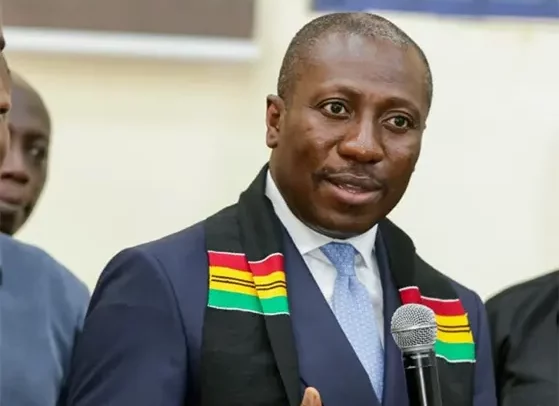
Alexander Afenyo-Markin
The Minority Leader, Alexander Afenyo-Markin, has rejected claims that the New Patriotic Party (NPP) is an elitist political tradition, stressing that the party’s ideology and governance record reflect a consistent commitment to empowering ordinary Ghanaians through a property-owning democracy.
Speaking at a lecture organised by the Institute of Economic Research and Public Policy (IERPP) in Accra last Monday, on the theme, “The Centre-Right Impact on the Political Landscape,” he said the Danquah-Dombo-Busia tradition was born out of the struggle for the rights of ordinary citizens rather than the protection of the privileged in society.
Quoting the words of Dr. Joseph Boakye-Danquah, he said, “the laws of the land should be dedicated specifically to enrich life, property and liberty of each and every citizen,” adding that the centre-right philosophy had consistently placed individual dignity and freedom at the heart of national development.
The Minority Leader, who traced the tradition’s resilience through political persecution and upheaval, stated that J. B. Danquah died in prison in 1965 after being detained without trial, Kofi Abrefa Busia was overthrown in the 1972 military coup and died in exile, while Chief S. D. Dombo was also jailed for his political beliefs.
According to Afenyo-Markin, despite the setbacks, the NPP tradition endured because its ideas were rooted “in a conviction about the nature of human dignity that could not be imprisoned or exiled.”
He explained that in the Fourth Republic, established under the 1992 Constitution, the tradition found institutional expression in the NPP, which was founded on July 28, 1992.
He said those 16 years under both President J. A. Kufuor and Nana Akufo-Addo provided the “clearest empirical test of what the tradition produces when it is given the opportunity to govern.”
Addressing some other misconceptions that continuously describe the NPP as elitist, he mentioned that its founders were educated men with an ideology that seeks to broaden ownership and opportunity for citizens.
“A tradition is not judged by where it comes from, it is judged by where it is going. When we look honestly at the direction of this tradition, we see a tradition that has consistently fought not to protect an elite, but to build a path that leads every Ghanaian into one.
“The concept of a property-owning democracy was never about safeguarding the wealthy but about ensuring that every citizen has a real path to becoming an owner, a stakeholder, a builder of something of their own,” he pointed out.
Afenyo-Markin, who is also the Member of Parliament for Effutu, said three major political traditions in Ghana’s post-independence history, including Nkrumahism, is rooted in the vision of Kwame Nkrumah, which favoured state ownership and centralised planning, with the state acting as the primary engine of development.
He said the Rawlings tradition, associated with military interventions and later constitutional rule, combined populist rhetoric with market-oriented structural adjustments.
The Minority Leader however noted that the Danquah-Dombo-Busia tradition has consistently supported a private sector-led economy, with the state acting as an enabler and regulator rather than a controller of productive activity.
“The tradition has never seized power by force, it has won at the ballot box, accepted electoral defeat when it occurred, and remained consistently committed to constitutional governance, multi-party democracy and peaceful transfer of power,” he stated.
Highlighting policy initiatives under NPP governments, Afenyo-Markin cited the One District, One Factory (1D1F) programme as a deliberate effort to democratise industrialisation, decentralise production and create jobs across the country.
He said the initiative reached 142 districts and created over 169,000 jobs, anchoring economic activity at the local level, adding that the introduction of the Ghana Card as a transformative national identification system has become a multifunctional document, empowering citizens to participate more fully in economic life.
Afenyo-Markin maintained that while other traditions placed the state at the centre of development, the centre-right philosophy places the rights-bearing individual at the heart of the national project.
The Minority Leader further described the Free Senior High School policy introduced by the NPP as a remarkable initiative that has expanded students’ access to education and increased secondary school enrollment across the country.
He recounted how he struggled to complete SHS as a teenager whose parents could not afford to pay his fees, yet opportunities now abound for all students who complete JHS to have free secondary school education.
“It is a tradition grounded not in the power of the state, but in the dignity and freedom of the individual citizen. These are not small differences, the party’s ideological stance has produced different kinds of governance, different institutional outcomes, and different consequences for the lives of ordinary Ghanaians,” he added.
Present at the event were former President Nana Akufo-Addo; some National Executives of the NPP, including the General Secretary, Justin Kodua Frimpong; the National Organiser, Henry Nana Boakye; the Chairman of the party’s Council of Elders, Hackman Owusu-Agyemang; as well as several Members of Parliament.
By Ebenezer K. Amponsah