
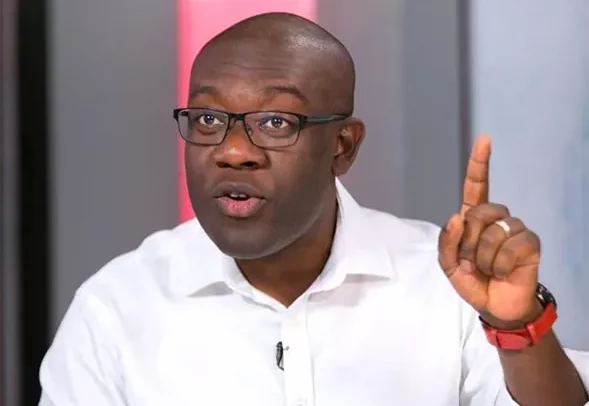
Kojo Oppong Nkrumah
The opposition New Patriotic Party (NPP) has rejected the government’s current approach to the review of the 1992 Constitution, demanding the establishment of a Constituent or Consultative Assembly before proposed amendments are taken through Parliament and a referendum.
The party said the scale of the proposed changes and the level of disagreement between the government and the Constitution Review Committee required a broader national deliberative process to build consensus.
Presenting the NPP’s position on the constitutional review exercise at a press conference in Accra yesterday, the party’s Policy Coordinator, Kojo Oppong Nkrumah, said the proposed amendments were far-reaching and could fundamentally alter the country’s constitutional order.
He said the Constitution Review Committee had recommended amendments to 147 of the Constitution’s 299 Articles, representing about 49 percent of the Constitution, in addition to 59 entirely new provisions.
According to Mr. Oppong Nkrumah, the 206 propositions collectively represented an overhaul of the Constitution rather than routine amendments.
He said the NPP therefore believed that the exercise should not be treated as ordinary business under Chapter 25 of the Constitution, but should follow a broad and representative process similar to those used in the nation’s previous constitutional arrangements.
The NPP Policy Coordinator said the party was particularly concerned about the government’s decision to proceed with its own position on a significant number of the review committee’s recommendations.
He said, according to the NPP’s assessment, the government had fully accepted 22 recommendations and partially accepted 25, leaving 100 of the 147 recommendations as areas of disagreement.
Mr. Oppong Nkrumah said the government had handed a zero draft reflecting its accepted and modified recommendations to the 11-member Constitution Review Implementation Committee and instructed it to draft the proposed amendments.
He said the committee had been given a November 2026 deadline to prepare the first amendment bills, with amendments to non-entrenched provisions expected to go before Parliament, while changes to entrenched provisions would be subjected to a referendum alongside the 2027 District Assembly elections.
The NPP objected to what it described as a process in which contested issues would be drafted rather than negotiated.
“The NPP therefore calls on the NDC government to bring a Constituent or Consultative Assembly Bill to Parliament and to establish a proper deliberative Assembly,” Mr. Oppong Nkrumah said.
He stated that such an Assembly should bring together political parties, organised labour, professional bodies, the National House of Chiefs, religious organisations, women’s groups, persons with disabilities, students and youth, the private sector, civil society and representatives from the regions.
The party said the proposed Assembly would provide a platform for stakeholders to deliberate on the 100 issues it considers to be in contention between the government and the independent Constitution Review Committee.
Among the issues identified by the NPP are the proposed five-year presidential term, the size of Parliament, whether a new category of Members of Parliament (MPs) should be appointed rather than elected, whether MPs should be allowed to serve as Ministers, the method of selecting District Chief Executives, and the independence and funding of oversight institutions.
Mr. Oppong Nkrumah said the NPP was not opposed to constitutional reform, noting that the party had consistently supported amendments to provisions of the 1992 Constitution that could strengthen accountability, decentralisation and the country’s institutions.
However, he indicated the scale of the current proposals required a different approach, pointing to previous constitutional exercises in 1969, 1979 and 1992, where expert bodies prepared proposals that were subsequently deliberated upon by broad-based representative assemblies.
The NPP also criticised the declaration that consultation on the review had been completed, arguing that there was no mechanism for political parties, organised labour, professional bodies and other stakeholders to negotiate the outstanding issues.
Mr. Oppong Nkrumah said the party would not support efforts to bundle the government’s preferred amendments into a referendum in the absence of a Constituent Assembly or a comparable mechanism for negotiated consensus.
He said the party’s position was intended to ensure that any constitutional changes reflected a broad national agreement rather than the position of a single political party.
The NPP said it supported taking the eventual outcome of a broad-based deliberative process to a referendum under Article 290 of the Constitution.
It further called on the government to reconsider the current timetable and establish the proposed Constituent Assembly to deliberate on the outstanding issues before the amendments were finalised.
By Ernest Kofi Adu