
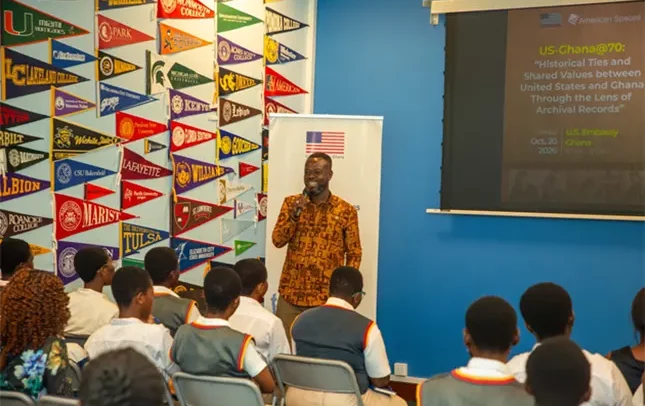
Josiah Gyimah during his presentation at the U.S embassy
The Head of Records Management Division at the Public Records and Archives Administration Department (PRAAD), Josiah Gyimah, has disclosed that the Department is currently digitising its paper records to reduce physical contact with fragile originals and to allow online access.
“We are using digitisation as one of the means of preserving because some of them are degenerating. We are also doing archival restoration, bringing newspapers from as old as the 1800s,” he said.
Mr. Gyimah was speaking at the US-Ghana@70 exhibition on the theme: “Historical Ties and Shared Values between United States and Ghana Through the Lens of Archival Records” in Accra.
He explained that once records are no longer needed for day-to-day government work, they are transferred to PRAAD for preservation and research.
However, he lamented the poor culture of record-keeping in Ghana, especially among families, churches, schools and private organisations.
Mr. Gyimah called on churches, mosques, shrines and schools to consciously keep archives, noting that for many ordinary Ghanaians, religious institutions are their only formal interaction with record-keeping.
He added that PRAAD is also working to retrieve private collections, including papers of prominent personalities, and to expand into audiovisual archives currently held by institutions like the Information Services Department and the former Ghana Broadcasting Corporation, now GTV.
Touching on the US-Ghana historical ties, Mr. Gyimah said archival records show that the relationship is less about problems than about people.
He cited a striking coincidence in names – St. James, Jamestown in Accra and Jamestown in Virginia – saying although the two locations do not have a direct historical lineage apart from the shared name, it leads to a reflection on a connected world.
He said the archives also reveal the painful history of the transatlantic slave trade, where Africans were sold and carried across the ocean, torn from their families and cultures, which explains why so many Americans trace their ancestry to the Ghanaian coast.
Mr. Gyimah said records on Ghana’s first President, Dr. Kwame Nkrumah, and his relationship with the United States through diplomacy, education, culture and sports show a friendship sustained by students, scholars, leaders and ordinary citizens across generations.
“They show me that a painful past need not prevent a shared prosperous future,” he said, adding that archives help recover forgotten voices and provide evidence rather than assumption.
By Prince Fiifi Yorke