

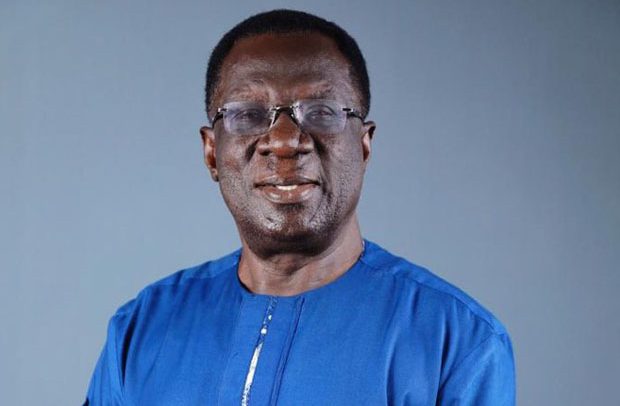
Prof. Christopher Ameyaw-Akumfi
A High Court in Accra on Wednesday admitted email correspondences and minutes which mentioned the Accra Sky Train project as one of the existing projects on the list of the Ghana Infrastructure Investment Fund (GIIF).
One of the documents in the email thread sent in September 2020 also lists the Sky Train as one of GIIF’s projects impacted by the COVID-19 pandemic, sharply contradicting claims by the prosecution’s first witness that the project was only mentioned at one of the board’s meetings.
Former Chief Executive Officer of GIIF, Solomon Asamoah and the erstwhile Board Chairman of the Fund, Prof. Christopher Ameyaw-Akumfi, have been charged before the court for their alleged involvement in unapproved $2 million investment in the Accra Sky Train project, which allegedly resulted in financial loss to the state.
The prosecution’s first witness, Yaw Odame-Darkwa, in his testimony, had claimed that although minutes from a board meeting referred to the Sky Train project, the minutes do not accurately reflect the board’s deliberations or decisions concerning the Sky Train project at any time.
Victoria Barth, counsel for Solomon Asamoah, has since that testimony embarked on a tangent to prove that the project was mentioned more than once, while trying to question the witness’s credibility before the court.
Mrs. Barth, in her latest cross-examination, introduced an email sent in 2020 by Secretary to the GIIF Board, with fifteen attachments, some of which mentioned the Sky Train project.
The tendering of the email correspondences was heavily opposed by Deputy Attorney General, Dr. Justice Srem-Sai, who questioned their relevance to the trial, basing his argument on section 51 and 52 of the Evidence Act.
According to him, the issues in this trial comprise an allegation that $2 million has been used by the accused persons to buy what they claim to be shares in a foreign company without approvals.
He said GIIF has elaborate processes for approving such investments, indicating that “these processes as would be shown later comprise of board approval, not just of the project but also specifically of the funds spent on the project, and because the claim that the money was used to buy shares in a foreign company, we also know that that kind of transaction requires the mandatory constitutional parliamentary approval.”
He said the issues in question therefore is whether there is board approval for the investment itself, board approval specifically for the payment of the money and parliamentary approval for the international financial approval.
“None of the documents being offered to be tendered in evidence has any consequence for any of these issues. Not even one document has consequence of approval for the Sky Train project, which is the subject matter of this trial,” Dr. Srem-Sai noted.
He further referenced section 52 of Evidence Act with emphasis on needles presentation of cumulative evidence.
The objection was opposed by Mrs. Barth, who argued that it is not in dispute that the email correspondence and accompanying attachments she was seeking to tender in evidence were received by the witness in September 2020 and the fact that one of the attachments – Risk Report specifically mentioned the Sky Train project.
This, she said, makes it relevant to the determination of whether the Sky Train project, which is said to have been existing, was in fact not approved by the board of GIIF.
She further argued that the witness in his evidence-in-chief denies the approval of Sky Train project yet in minutes of the GIIF board tendered through him, the witness in his capacity as the Chairman of the Audit Committee presented the committee’s report which was first circulated via email, which touched on the impact of COVID-19 on the investments and operations of GIIF, including the Accra Sky Train project which was clearly acknowledged as an existing project impacted by COVID-19.
“This same PW1 (witness) disputed the accuracy of some minutes which are in evidence before this court. What better evidence to corroborate the minutes than an email he received with his own committee’s report which he then presented at a meeting of the board whose minutes are captured in exhibit 9?” Mrs. Barth queried.
She added that the email correspondence is therefore not only useful or relevant but also for testing the accuracy of the witness’s recollection of events and ultimately his credibility.
“It is my humble submission that the email correspondence has substantial probative value. The prosecution has had ample time to verify it and the grounds of undue delay or waste of time do not arise to invoke your discretion under section 52,” she added.
The court, presided over by Justice Audrey Kocuvie-Tay, after listening to both sides, admitted the email correspondences “for their worth.”
BY Gibril Abdul Razak