
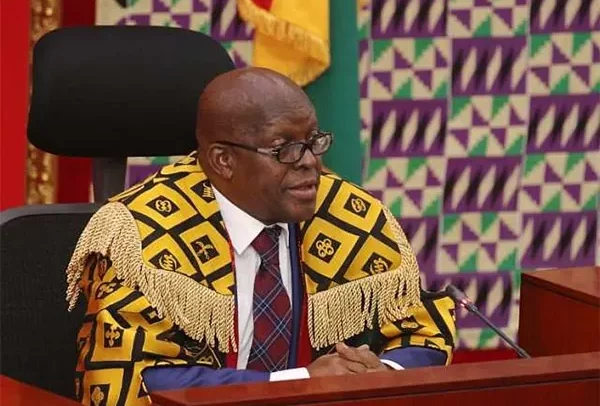
Alban Bagbin
Speaker of Parliament, Alban Sumana Kingsford Bagbin, has dismissed a private members’ motion by the Minority seeking the establishment of an ad hoc committee to investigate the circumstances surrounding major cocaine seizures linked to the country, ruling that the proposed parliamentary inquiry could prejudice ongoing criminal proceedings before the courts.
The Speaker said he had carefully considered the motion, its proposed terms of reference, the continuing investigations, pending judicial proceedings, previous practice of the House and the relevant provisions of the Standing Orders.
He subsequently ruled that the motion was inadmissible under Standing Orders 5, 6 and 103(f), which deals with matters that are before the courts in a manner that could prejudice the interests of parties to a case.
According to Mr. Bagbin, the proposed inquiry went beyond an incidental overlap with the court cases and would require Parliament to examine factual matters directly connected with the criminal proceedings.
He said the committee would have had to assess the transactions, the actions of various actors, the processing and movement of the consignments and the reasons behind decisions taken at ports of entry.
“The combined effect of undertaking this evaluation, assessment and investigation would, at the end of the day, be to determine the very issues that the court of competent jurisdiction is supposed to determine,” he said.
The Speaker, therefore, concluded that allowing the motion to proceed in its current form could prejudice the interests of parties involved in the pending cases.
Mr. Bagbin, however, stressed that his ruling did not mean Parliament could never inquire into the broader issues surrounding the cocaine seizures.
“I am not ruling that Parliament can never inquire into these matters. Neither am I suggesting that the matters raised by the requesting members are unimportant,” he said.
He said Parliament remained entitled to seek information from Ministers, scrutinise the performance of public institutions, examine the adequacy of legislation and regulatory frameworks and consider broader questions concerning port and border security and narcotics policy.
What Parliament could not do, he said, was conduct a parallel fact-finding exercise on matters already engaging the criminal justice system.
The Speaker had indicated that the extraordinary sitting itself had been properly convened under Article 112(3) of the 1992 Constitution after a request by the requisite number of MPs.
The request, dated September 18, 2026, was submitted by the First Deputy Minority Whip and Member for Tolon, Habib Iddrisu, on behalf of other MPs.
Mr. Bagbin said the request had secured more than the constitutionally required 15 percent of the membership of Parliament and, therefore, he had a constitutional duty to summon the House.
He explained that summoning Parliament did not automatically make the matters contained in the request admissible as substantive business of the House.
Ad Hoc Committee
On Monday, September 28, 2026, Mr. Iddrisu subsequently submitted notice of a private members’ motion under Order 102 of the Standing Orders seeking the establishment of an ad hoc committee to conduct a “thorough, transparent and full-scale” investigation.
The proposed inquiry was to cover the processing, inspection, clearance and export of the relevant consignments, the persons, companies and institutions involved, the status of investigations, arrests and prosecutions, international cooperation and intelligence sharing, trafficking networks and security at points of entry and exit.
Mr. Bagbin said the motion could not be considered in isolation from the criminal cases already before the courts.
He disclosed that official searches at the court registries showed four cases pending in relation to narcotics matters connected to the subject of the proposed motion, involving about 21 persons standing trial.
He said the proposed parliamentary committee could receive evidence and hear witnesses on factual questions that could also arise during the criminal proceedings.
The Speaker referred to earlier parliamentary discussions on the sub judice rule by former Speakers Peter Ala Adjetey and Edward Doe Adjaho, saying the rule was not an automatic prohibition against parliamentary consideration of every matter connected with litigation.
The critical issue, he said, was whether the nature and scope of the proposed parliamentary proceedings created a sufficient risk of prejudice to parties in the pending cases.
Mr. Bagbin also reminded MPs that a private members’ motion was defined under the Standing Orders as a request by a member who was not acting in the capacity of a member of the leadership or a committee of the House.
Minority Reaction
Reacting to the ruling, the Minority Leader, Alexander Afenyo-Markin described it as a setback for parliamentary oversight.
He argued that the Minority’s proposed inquiry was focused on institutional accountability rather than determining the criminal liability of accused persons.
According to him, Parliament had a constitutional mandate under Article 103 to investigate and inquire into the activities and administration of ministries, departments and agencies.
Mr. Afenyo-Markin said the proposed committee could have examined issues such as container scanning, customs controls, port access systems, intelligence sharing, freight forwarding regulation, export controls, warehouse security and maritime supervision without determining the guilt or innocence of any accused person.
He maintained that the courts were concerned with the criminal liability of individuals, while Parliament’s concern was the performance and accountability of state institutions.
The Minority Leader said the Speaker could have admitted the motion while directing the committee to avoid matters directly related to the determination of criminal guilt or evidence before the courts.
He accused the Majority of using its numerical strength to weaken parliamentary scrutiny, but said the Minority would continue to pursue the narcotics issue through constitutional and parliamentary avenues.
Mr. Afenyo-Markin said the Minority considered the seizures a matter of national security, institutional accountability and Ghana’s international reputation, insisting that the issue would not be allowed to “rest.”
By Ernest Kofi Adu, Parliament House