
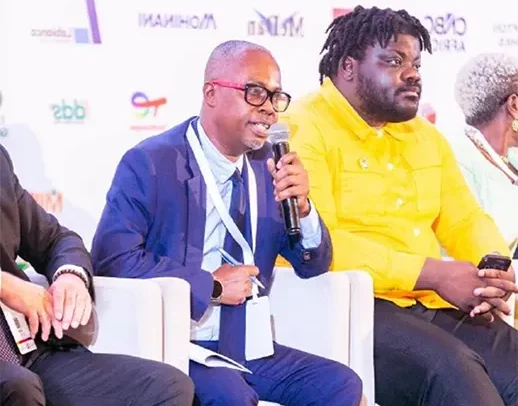
Philip Amoateng speaking at the summit
The Managing Director of Telecel Cash and Digital Transformation, Philip Amoateng, has called on Ghana to treat internet connectivity as a fundamental human right, arguing that the country cannot achieve its ambition of becoming a leading and inclusive digital economy without making digital infrastructure a national development priority.
Speaking at the 10th Ghana CEO Summit in Accra, Mr. Amoateng stressed that economic transformation would require more than investments in roads, bridges and other physical infrastructure.
Addressing the summit’s opening high-level leadership dialogue on the theme, “From Vision to Action: Leadership, Technology and Industrialisation as Catalysts for Ghana’s Economic Transformation,” he urged policymakers to integrate internet connectivity into every major infrastructure project across the country.
The summit was attended by business leaders, policymakers, investors and industry experts, with President John Mahama delivering the keynote address as Special Guest of Honour.
Mr. Amoateng noted that Ghana’s development planning has traditionally focused on physical infrastructure while overlooking digital connectivity, which he described as equally essential for national growth.
“As a nation, we tend to focus only on physical highways when building national infrastructure, without thinking about incorporating internet connectivity from the foundation. If we are serious about connecting every community in Ghana, our national focus must be to prioritise digital infrastructure in every development plan,” he said.
He further called for all second-cycle educational institutions to be connected to the internet, describing digital access as critical to preparing young people for participation in the modern economy.
Touching on spectrum licensing policies, Mr. Amoateng cautioned against approaches that prioritise short-term government revenue at the expense of long-term connectivity goals.
While acknowledging that upfront licence fees provide immediate income for governments, he argued that excessive costs could slow investments in telecommunications infrastructure and limit the expansion of digital services.
Using the nation’s 5G licensing process as an example, he advocated a balanced approach that includes favourable financing arrangements and incentives for telecom operators that extend connectivity to public institutions and underserved rural communities.
His remarks come as the country seeks to accelerate digital transformation and expand access to high-speed internet services nationwide.
At the summit, Telecel Ghana’s Chief Executive Officer, Ing. Patricia Obo-Nai, was honoured with the “CEO of the Year – Telecom” award in recognition of her leadership and the company’s continued growth in revenue, profitability and customer numbers.
Launching the CEO-Government Compact 2026, a new framework aimed at strengthening accountability and innovation in public-private partnerships, President Mahama underscored the importance of sustained collaboration between government and the private sector.
He said the relationship must go beyond annual engagements and be reflected in concrete investments, innovation, industrial growth and job creation.
A Business Desk Report