
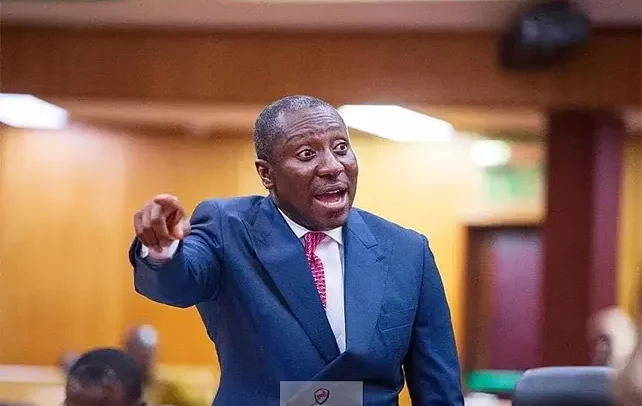
Alexander Afenyo-Markin
The Minority Leader, Alexander Afenyo-Markin, has launched a scathing attack on the Regional and District Tribunals Bill, warning that it could undermine the country’s justice system and revive what he described as the “kangaroo courts” associated with the country’s military era.
Delivering his closing remarks last Friday before Parliament adjourned sine die, Mr. Afenyo-Markin urged President John Dramani Mahama not to assent to the bill, arguing that it ignored the recommendations of the President’s own Constitutional Review Committee and posed serious risks to judicial independence.
He maintained that while the 1992 Constitution permits the establishment of tribunals, the Constitutional Review Committee chaired by Professor H. Kwasi Prempeh had recommended their abolition in favour of the regular court system.
“That Committee studied the very question of the tribunals and, in December last year, reported to the President. Its advice was simple: expunge the tribunal system and replace it with ordinary courts,” he said.
According to the Minority Leader, the government disregarded that recommendation and used its parliamentary majority to pass the bill.
“The President’s own reviewers told him to close this door. Instead, his side in Parliament forced it open, at midnight, on Friday the 16th of July, while most of Ghana slept. This Minority refused to add our voice to that vote. We stood up. We walked out. So history would have no doubt where we stood,” he stated.
Mr. Afenyo-Markin recalled the operation of Public and Community Tribunals during the 1980s, saying they became synonymous with human rights abuses.
“We have walked this dangerous road before. In the 1980s, Public Tribunals and Community Tribunals were accused of grave human rights abuses. They earned a name, and not a kind one: ‘kangaroo courts’,” he said.
He cited comments by Professor Kwesi Yankah, who reportedly described the legislation as “a revolutionary monster nicely cloaked in fugu democracy” and warned that it represented “the return of terror.”
The Minority Leader also questioned provisions allowing tribunal panel members to sit even if they are not legally trained.
He argued that permitting non-lawyers to adjudicate serious criminal matters, including fraud, tax offences and illegal mining cases, while enjoying immunity for their decisions, posed significant dangers to the administration of justice.
“Power, without training, wrapped in immunity, is not a small risk in a country with our history,” he said, adding that if trained High Court judges occasionally have their decisions overturned on appeal, the risks would be even greater with untrained tribunal members.
Mr. Afenyo-Markin warned that laws enacted to target political opponents could ultimately be turned against those who introduced them.
“Let not the National Democratic Congress (NDC) forget that in our history some of the people who have led or supported the passage of controversial bills have ended up being the victims of it soon afterwards,” he cautioned.
He called on President Mahama to withhold assent to the bill and return it to Parliament for reconsideration.
“Standing firmly behind our flagbearer, Dr. Mahamudu Bawumia, we say to President Mahama: do not sign this bill. Send it back. Listen, for once, to your own Committee. A tribunal built to be used against your opponents today can be turned on you tomorrow. Nobody wins that game. Only the law loses,” he said.
Unfair Targeting
Beyond the tribunal legislation, the Minority Leader accused the government of using state investigative and prosecutorial institutions to intimidate members of the opposition.
He alleged that New Patriotic Party (NPP) Members of Parliament and party officials had been unfairly targeted because of their political views.
“A government that fears its critics has already told us something horrifying about itself: it is inflicting a new culture of silence on this nation,” he asserted.
Mr. Afenyo-Markin also criticised what he described as the abuse of the nation’s bail regime, indicating that stringent bail conditions were being used to punish opposition figures before they had been tried.
“Bail should protect liberty. It should never punish a person before they are even tried,” he said, urging Parliament to reform the law to prevent what he termed excessive bail conditions.
Revival Criminal Libel
He further accused the government of attempting to revive criminal libel through the continued enforcement of Sections 207 and 208 of the Criminal Offences Act, 1960, which criminalise insults and the publication of false news.
The Minority Leader disclosed that the Minority had already introduced a Private Member’s Bill seeking to repeal the provisions.
“While we do not support irresponsible or reckless speech, we are of the firm conviction that no citizen should go to prison for mocking a leader, or for getting a fact wrong. Those are matters our civil litigation should deal with,” he said.
He appealed to the Majority to support the proposed amendments, saying Ghana’s democracy would be strengthened when citizens could freely express their views without fear of criminal prosecution.
By Ernest Kofi Adu, Parliament House