
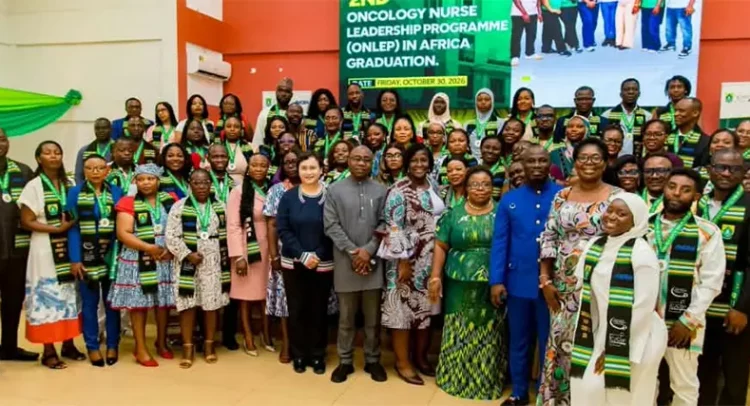
The Vice Chancellor of UHAS and graduating class
The University of Health and Allied Sciences (UHAS) has produced a new generation of oncology nurse leaders from across Africa, graduating 60 nurses from 17 countries with specialised skills to strengthen cancer care and leadership on the continent.
The graduates, comprising 44 women and 16 men, completed a six-month postgraduate certificate programme under the second cohort of the Oncology Nurse Leadership Programme (ONLEP), an initiative designed to equip nurses with the expertise to lead improvements in cancer prevention, treatment, patient care and health systems.
Speaking at the graduation ceremony, the Vice Chancellor of UHAS, Prof. Lydia Aziato, said the programme was part of an ambitious five-year plan to train 240 oncology nurses across Africa. She said the initiative was being implemented through a partnership between UHAS, City Cancer Challenge (C/Can), the International Society of Nurses in Cancer Care (ISNCC) and funding partner Amgen.
Prof. Aziato said the highly competitive programme exposed participants to oncology leadership, health services management, financial management, quality assurance, psycho-oncology, research, policy advocacy and leadership project development.
She said the training had delivered measurable improvements in the leadership competencies of participants, with those rated “very good” increasing from just seven before the programme to 42 after completion. According to her, ONLEP alumni were already making their mark across Africa through international awards, leadership recognitions and contributions towards establishing specialised oncology services.
Consultant Surgeon at the Korle-Bu Teaching Hospital, Prof. Florence Dedey, who delivered the keynote address, warned that cancer remained a major public health challenge, particularly in low- and middle-income countries.
She said Africa’s fight against cancer required more than sophisticated technology and medicines, stressing that skilled, compassionate and innovative healthcare professionals were critical to improving patient outcomes.
Prof. Dedey charged the graduates to champion research, innovation, multidisciplinary teamwork and patient-centred care while taking steps to protect their own mental and physical well-being against professional burnout.
She further reminded the graduates that leadership was not about titles but influence and action, urging them to use their new skills to drive meaningful change in their institutions and communities. Representatives of the ISNCC, Nursing and Midwifery Council and Ghana Health Service also praised UHAS and its partners for investing in oncology nursing leadership and strengthening cancer care across the region.
The overall best graduating participant, Amos Azure of the Tamale Teaching Hospital, expressed gratitude to UHAS and the programme partners, saying the training had significantly strengthened his professional practice and leadership abilities.
FROM Daniel K. Orlando, Ho