
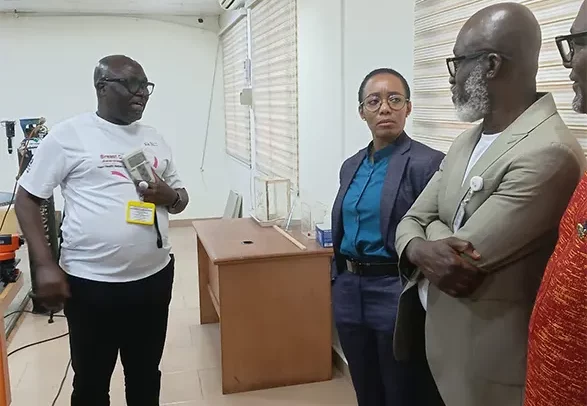
Dr. Zanetor Agyeman- Rawlings interacting with some officials of GAEC
The Minister for Environment, Science and Technology, Dr. Zanetor Agyeman-Rawlings, has called on the ministry’s agencies to retain nuclear scientists as well as expose students to career opportunities in nuclear science and technology to improve the human resource capacity needed to support the nuclear science and technology sector.
The minister, who made the call during working visits to the ministry’s agencies – the Ghana Atomic Energy Commission (GAEC), National Biosafety Authority (NBA) and Nuclear Regulatory Authority (NRA) to familiarise herself with their operations and challenges, said the GAEC should train young scientists to replace retiring professionals and ensure that investments in nuclear infrastructure are matched by the availability of skilled personnel.
Dr. Agyeman-Rawlings said training professionals in specialised scientific fields could sometimes take at least 15 years, making it important for the country to retain experienced scientists as more young people are encouraged to pursue careers in nuclear science and related disciplines.
Though she urged students to pursue career goals they were interested in, Dr. Agyeman- Rawlings entreated the agencies to introduce programmes that would enable students to explore career opportunities in scientific fields apart from the conventional professions which they were familiar with.
She also proposed that students from the top three or five schools in the National Science and Maths Quiz (NSMQ) could be invited to visit the institutions, interact with scientists and learn from them.
“We need to show what those things are because there are people who don’t know that these are options in Ghana as a career path. Let’s use science as a common language to bridge the gaps between us and create a platform on which the next generation has something beautiful to inherit and build upon,” she stated.
“You need to improve the presentation of scientific information in your institutions to make your work more accessible and interesting to students and the public,” she pointed out.
Dr. Agyeman-Rawlings said parts of the observatory at GAEC, that did not pose national security concerns, could also be opened to the public to promote understanding of space science and technology, adding that public awareness of the institutions’ work would help young people appreciate the career opportunities available in fields such as nuclear physics, genetics and other specialised scientific disciplines.
She said the country needed to ensure that its human resource capacity kept pace with investments in infrastructure, adding that nuclear science had applications in medicine, mining, water testing and archaeological research.
Director-General of GAEC, Prof. Samuel Boakye Dampare, thanked the minister for the visit and disclosed that inadequate funding for research had prevented some scientific concepts from advancing to the full research stage.
Prof. Dampare explained that the commission had to maintain government-owned installations while relying on limited internally generated funds to meet its operational expenses, and called for the modernisation of the commission’s laboratories to enable scientists to work with facilities suited to current scientific and technological demands.
He also raised concerns about encroachment on the commission’s land, particularly around its radioactive waste management centre where unauthorised access could pose serious risks to people and national security.
He added that the commission was reviewing the legislation establishing it to introduce provisions that would strengthen its ability to execute its mandate.
The Chief Executive Officer of the National Biosafety Authority, Mr. Kwame Dei Asamoah-Okyere, said the institution had made progress in establishing a functional biosafety system to support the country’s development goals.
The Authority, in a presentation, however mentioned inadequate and obsolete logistics, dilapidated office facilities, insufficient budgetary support and staffing shortages as major challenges.
The Authority said the challenges therefore affected its ability to perform key regulatory functions, and could expose the public and the environment to potential biosafety risks.
The last port of call by Dr. Agyeman-Rawlings was the Nuclear Regulatory Authority (NRA), where its Director General, Prof. Francis Otoo, thanked the minister for the visit and appealed for government support to recruit additional personnel as well as provide them with the support needed to improve operations.
The minister assured the institutions of government’s support, and urged them to develop a roadmap outlining how the government could collaborate with them to address their challenges.
By Ebenezer K. Amponsah