
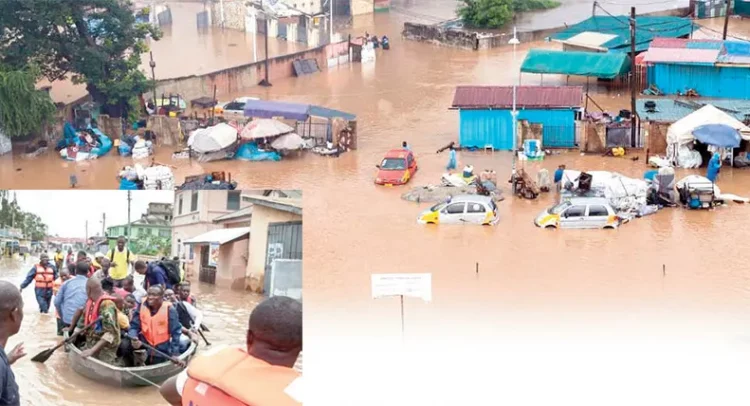
Thirty people have lost their lives in devastating floods that struck parts of Greater Accra and the Central regions, while more than 38,000 others have been displaced, the Minister for the Interior, Mohammed-Mubarak Muntaka, has disclosed.
Presenting a statement in Parliament yesterday, the minister said 12 people died in Monday’s floods in Greater Accra Region, with seven others still missing, while a further 18 people lost their lives in separate flood-related incidents in the Central Region over the past two weeks.
Mr. Muntaka said preliminary assessments showed that 7,761 households, comprising 38,802 people, had been displaced across 18 Metropolitan, Municipal and District Assemblies (MMDAs) in the Greater Accra Region following the torrential rains.
He explained that 25 communities were severely affected after 169.2 millimetres of rain fell within a day, making it the fourth-highest single-day rainfall recorded in the country since 1995.
According to the minister, Ga East recorded the highest number of deaths with five fatalities and six persons missing, while Ayawaso Central recorded three deaths and one missing person. Tema West also recorded three deaths, while Ledzokuku recorded one fatality.
He extended the condolences of the government and the entire country to families that lost relatives, assuring victims that the government was working to provide relief and restore normalcy.
Mr. Muntaka disclosed that the Central Region also suffered extensive destruction over the past two weeks, with 58 houses collapsing across several districts, including Cape Coast, Gomoa West, Agona West, Asin North, Mfantseman and Effutu.
He said 18 people died in the region through building collapses and drowning, which underscored the widespread impact of the heavy rains beyond Greater Accra.
The minister noted that more than 60 communities in the Volta Region were also affected, although no life-threatening incidents were reported there.
In the Western North Region, over 1,200 people were displaced after floodwaters submerged communities around Samreboi.
Mr. Muntaka attributed the disaster partly to human activities such as dumping refuse into drains and building on waterways, but stressed that the unprecedented rainfall would have overwhelmed drainage systems even under better conditions.
He revealed that the Ghana Meteorological Agency recorded 593.2 millimetres of rainfall in June, the highest monthly rainfall ever recorded in the country’s history, surpassing previous records set in 2002 and 2015.
The minister appealed to Parliament and the public not to politicise the disaster, saying flood management required a collective national effort involving government institutions, local assemblies and citizens.
“Disasters will always come,” he said. “What matters is how prepared we are to minimise the loss of lives and property.”
By Ernest Kofi Adu, Parliament House