
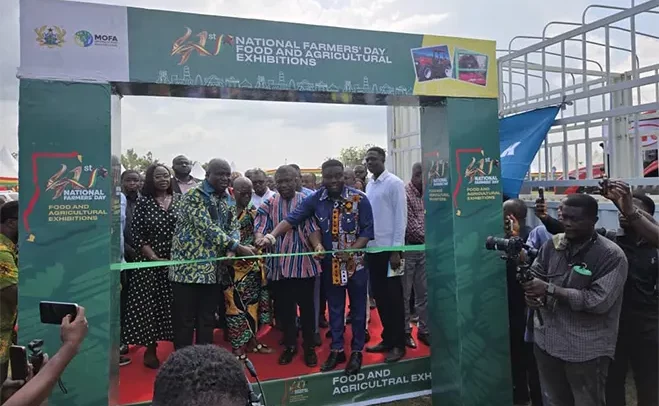
Eric Opoku with Gabriel Tanko Kwamigah Atople and James Gunu cutting the tape to officially open the fair
The 41st National Farmers’ Day celebration officially opened on Monday at the Ho Sports Stadium with the launch of the 2025 National Agricultural Fair, drawing thousands of farmers, agripreneurs, policymakers, investors and exhibitors from across the country.
Held under the theme “Feed Ghana, Eat Ghana, Secure the Future,” the ceremony set the stage for a week-long showcase of innovation, technology and partnerships aimed at reinforcing Ghana’s food systems and agricultural resilience.
Council of State Representative for the Volta Region, Gabriel Tanko Kwamigah Atople, who was the keynote speaker, underscored the critical interdependence that holds Ghana’s agricultural value chain together, cautioning that the absence of even a single actor can trigger widespread disruption.
Speaking at the opening ceremony, Mr. Atople emphasised that farming is not an isolated practice but a network of interconnected roles from producers and processors to traders and consumers. He noted that when any link within this system fails, the impact extends far beyond the farm gate.
Mr. Atople said the loss of one player, whether a farmer, a processor, or a market intermediary, can destabilise livelihoods, break supply chains, and ultimately affect food availability and economic stability.
He reiterated the need for stronger collaboration, support systems, and policies that protect all actors within the agricultural ecosystem, stressing that safeguarding each link is essential to sustaining national food security and rural prosperity.
“Agriculture is not a competition, it is a collaboration that determines the wellbeing of our society,” he stated. “Food security is national security. A nation that cannot feed itself risks instability and dependence.”
Mr. Atople lauded the Volta Region for its strategic contribution to national food production, pointing to the region’s fertile lands, expanding ecological zones and growing youth participation in agribusiness. He emphasised the region’s increasing influence in rice cultivation, and urged stronger investments in irrigation, mechanisation, improved seeds, storage and branding for locally produced rice.
He further called on government and stakeholders to confront persistent challenges including rising input costs, inadequate machinery, poor roads, post-harvest losses, climate variability and fluctuating market prices.
The Minister for Food and Agriculture, Eric Opoku, commended the fair as a practical platform for learning, research exchange and agribusiness advancement. He applauded exhibitors for showcasing improved seed varieties, livestock breeds, mechanisation technologies, digital advisory tools and agro-processing equipment that support the modernisation of Ghana’s food ecosystem.
Representing the Minister for Fisheries and Aquaculture Development, Chief Director Miriam Kpakpa reaffirmed government’s commitment to sustainable fisheries and the expansion of aquaculture. She noted that the fisheries sector remains central to national nutrition, accounting for nearly 60 percent of Ghana’s animal protein intake and supporting the livelihoods of about three million citizens.
She outlined recent government interventions, including improved fisheries governance under the new Fisheries and Aquaculture Act, protection of artisanal fishing zones, expanded hatchery capacity and investment in modern landing sites across coastal and inland communities.
The Volta Regional Minister, James Gunu, emphasised the region’s continued readiness to contribute substantially to Ghana’s food security agenda. He highlighted significant progress in rice production, cassava processing, aquaculture, vegetable farming and livestock development, and praised President John Dramani Mahama for selecting the Volta Region as host of the national celebration.
“Our farmers, fishers and processors remain the backbone of our economy, and the Volta Region salutes every one of them,” he stated, urging participants to embrace innovation, forge partnerships and explore market opportunities available at the fair.
The opening ceremony brought together traditional leaders, Metropolitan, Municipal and District Chief Executives (MMDCEs), development partners, agribusinesses, university researchers, youth farmers, and students from tertiary and second-cycle institutions.
This year’s week-long Farmers’ Day observance will feature exhibitions, business networking, market linkages and expert-led knowledge-sharing sessions. The celebrations will climax with a grand national awards ceremony to honour outstanding farmers and fishers for their exceptional contributions to Ghana’s food security and socio-economic development.
FROM Daniel K. Orlando