
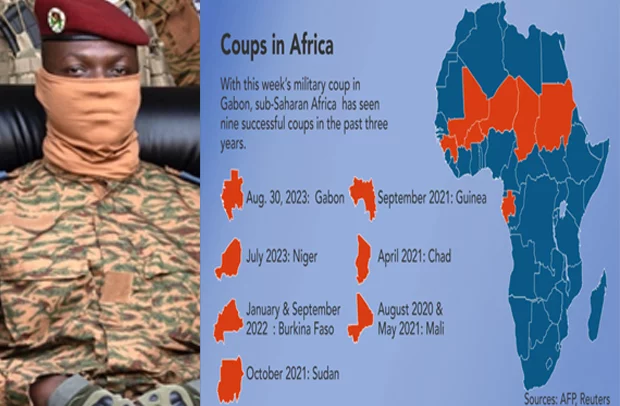
Captian Ibrahim Traoré. Coups in Africa
The resurgence of military coups across Africa since 2020 represents a troubling regression in the continent’s democratic trajectory.
From the attempted coup in Benin on December 7, 2025, led by Lieutenant Colonel Pascal Tigri, to the successful overthrow in Guinea-Bissau on November 26, 2025, orchestrated by Brigadier General Dinis Incanha, the contemporary landscape reveals a disturbing pattern.
This wave includes coups in Gabon (August 30, 2023) under General Brice Oligui Nguema, Niger (July 26, 2023) by General Abdourahamane Tchiani, the dual coups in Burkina Faso (September 30, 2022, and January 24, 2022) led first by Lieutenant Colonel Paul-Henri Sandaogo Damiba and then Captain Ibrahim Traoré, Sudan’s October 25, 2021, power grab by General Abdel Fattah al-Burhan, Guinea’s September 5, 2021, takeover by Colonel Mamady Doumbouya, and Mali’s May 24, 2021, coup orchestrated by Colonel Assimi Goïta.
These events underscore a fundamental paradox: while military coups often emerge from legitimate grievances about institutional weakness and governance failures, they invariably exacerbate rather than resolve the underlying crises they purport to address.
The justifications offered by coup leaders are remarkably consistent across contexts. Tchiani in Niger cited the country’s deteriorating security situation as grounds for his actions. Traoré in Burkina Faso accused his predecessor, Damiba, of failing to contain jihadist insurgencies despite having seized power on precisely the same premise. Doumbouya in Guinea condemned President Alpha Condé’s corruption and constitutional manipulation. Al-Burhan in Sudan claimed he was preventing civil war and protecting the democratic transition.
These rationales, while often resonating with frustrated populations, reveal a critical misunderstanding: military force cannot build the transparent, accountable, inclusive institutions necessary for sustainable governance. Instead, coups create a vicious cycle wherein weak institutions justify military intervention, which further undermines institutional development, thereby establishing conditions for future coups.
The Institutional Vacuum: How Coups Reflect and Worsen State Fragility
Africa’s recent coups have emerged predominantly in states characterised by profound institutional weaknesses. Mali, which experienced two coups in nine months (August 2020 and May 2021), exemplifies this pattern. The country ranked near the bottom of the UN’s Human Development Index and faced concurrent crises: a brutal jihadist insurgency that displaced hundreds of thousands, pervasive corruption, and democratic backsliding manifested through electoral irregularities.
When President Ibrahim Boubacar Keïta was overthrown in August 2020, many Malians initially supported the military’s intervention. Yet within months, Vice President Assimi Goïta orchestrated a second coup against the transitional civilian government, demonstrating that military rule breeds instability rather than resolution.
Burkina Faso’s trajectory illustrates this dynamic even more starkly. Nearly 40 per cent of the country was controlled by non-state armed groups by September 2022, reflecting the state’s profound inability to maintain territorial integrity or protect citizens. Lieutenant Colonel Damiba justified his January 2022 coup by citing President Roch Kaboré’s failure to address the security crisis. However, Damiba’s regime proved equally ineffective, losing even more territory to jihadists.
When Captain Traoré overthrew Damiba in September 2022, he employed identical justifications—poor security management and inadequate support for frontline troops. The coup resulted in the suspension of major military operations in conflict zones and diverted crucial resources from the frontlines, demonstrating how political instability directly undermines the security objectives that coup leaders claim to prioritise.
The institutional damage extends far beyond security sectors. In Guinea, despite Doumbouya’s promises to combat corruption through special courts, there emerged a widespread sense that investigations and prosecutions were being used selectively rather than addressing systemic corruption.
The transitional authorities repeatedly delayed constitutional referendums and failed to allocate budgets for promised elections, while forcefully crushing dissent and arresting civil society activists, journalists, and opposition members. This pattern of broken promises and intensified repression characterises virtually every recent coup, revealing a fundamental truth: military governments lack both the legitimacy and the institutional mechanisms to implement meaningful reforms.
Economic Deterioration: The Material Costs of Political Instability
The economic consequences of military coups are devastating and immediate. Countries that are poorer and whose democracies are less stable have historically been more prone to takeovers, with fifteen of the twenty countries topping the 2022 Fragile States Index being in Africa, twelve of which have experienced at least one successful coup. This correlation is not coincidental but causal in both directions: weak economies create conditions for coups, and coups further weaken economies through multiple mechanisms.
International sanctions represent the most immediate economic shock. Following Niger’s July 2023 coup, ECOWAS imposed sanctions including border closures, a no-fly zone, suspension of commercial transactions, and cuts to electricity supply exceeding 70 per cent of Niger’s total. The junta announced a 40 per cent budget cut due to these “heavy sanctions,” exposing the country to major drops in external and internal revenue. The electricity crisis particularly devastated ordinary citizens, with Niger’s state utility company able to meet only between one-quarter and one-half of demand across the country.
Mali’s experience demonstrates the compounding nature of these economic shocks. After Goïta’s May 2021 coup, 37.6 per cent of Malians surveyed indicated they went without food at least several times in 2021-2023, representing a significant deterioration in food security.
The suspension of aid from traditional partners, combined with operational disruptions caused by political instability, created acute humanitarian crises. When France suspended military cooperation and eventually withdrew its forces, Mali lost not only security assistance but also associated economic benefits and legitimacy in international forums.
In Burkina Faso, the country experienced the most significant decline of any African nation in the Absence of Armed Conflict and Absence of Violence against Civilians since 2017, with catastrophic economic ramifications.
The deteriorating security forced aid organisations to suspend operations, while blockades of towns by armed groups made it impossible to reach populations facing starvation. The UN highlighted that more than 630,000 people were on the brink of starvation, representing the worst hunger crisis in six years.
Guinea’s economic trajectory following its September 2021 coup reveals how political instability destroys development gains. Acute food insecurity skyrocketed to an estimated 11 per cent of Guinea’s 14 million people from 2.6 per cent in 2020, with over one million Guineans facing food crisis.
The explosion of Guinea’s main fuel depot in December 2023 led to electricity shortages and increased fuel prices, compounding citizens’ frustrations with poor government service delivery. These material hardships directly contradicted Doumbouya’s promises of improved living conditions and illustrated how coups destroy rather than build economic prosperity.
Source: Eric Akuamoah-Boateng