
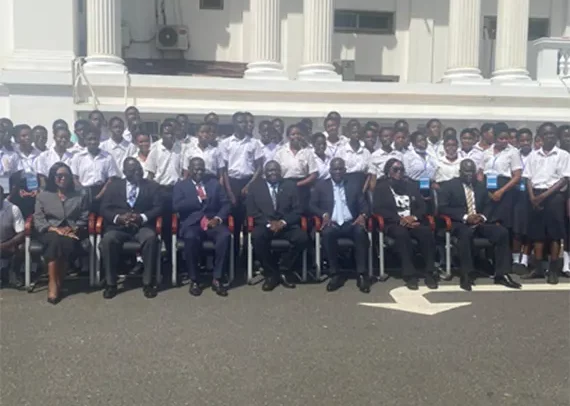
Dignitaries in a group photograph with students
The Chief Justice, Paul Baffoe Bonnie, has assigned three High Court judges who will oversee cases submitted by the National Anti-Illegal Mining Secretariat (NAIMOS).
This announcement was made yesterday during the annual Chief Justice’s Mentoring Programme, by a Justice of the Supreme Court, Gabriel Pwamang, in Accra.
“The Judiciary under the Leadership of the Chief Justice, His Lordship Justice Baffoe-Bonnie, has already allocated three High Court judges, and they are being refurbished to specifically deal with cases coming from the NAIMOS and other related matters. We are hoping that early next year, we’ll launch these courts and make them available for you,” he said.
The Minister for Lands and Natural Resources, Emmanuel Armah-Kofi Buah, said the government is committed to eradicating environmental degradation as well as reclaiming lands and water bodies affected by illegal mining, adding that government is working to cut out corruption and opacity in operations that degrade lands and water bodies.
“Government is totally committed to eradicating this menace, to halt the degradation and to reclaim our lands, make our forests green again and make sure that our waters are turned blue. And this commitment is what built the five pillars strategy that this government is focusing on, and one is the stakeholders, engagement and collaboration, such as the one we are heading today,” he said.
He further indicated that “we are trying to address this challenge by cutting out the corruption and the opacity that fuel illegal mining operations, the third is reclaiming degraded lands and polluted water bodies to turn our forest back to green, and our waters back to blue.”
The minister added that the government is tracking and geo-fencing excavators to ensure they are used only in designated areas, and has tracked and geo-fenced 1,200 excavators.
The Chief Justice’s Mentoring Programme is an initiative by the Judicial Service aimed at empowering young people, particularly vulnerable girls (kayayei).
It seeks to inspire interest in law, foster character traits such as patriotism and integrity, provide life skills, and expose participants to the judicial system through interactions with judges, visits to courts, and support from partners like the United Nations Population Fund (UNFPA).
The programme was launched by former Chief Justice Georgina Wood in 2007.
By Vera Owusu Sarpong