
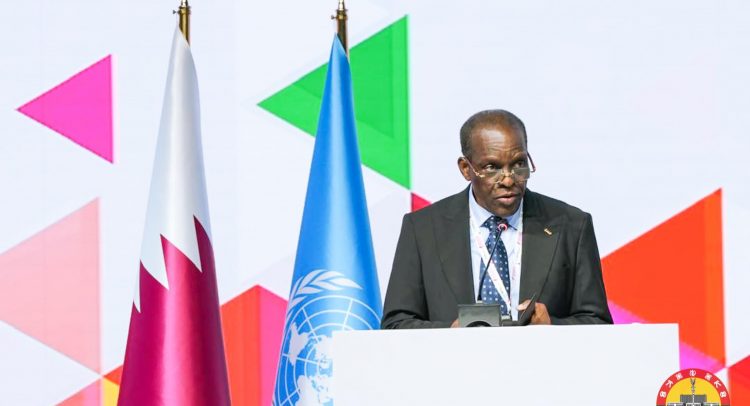
The Speaker of Parliament, Alban Sumana Kingsford Bagbin, has reinforced Ghana’s standing as a leading force in global anti-corruption efforts after the country spearheaded the adoption of a historic resolution at the world’s largest anti-corruption summit in Doha, Qatar.
Addressing the 11th Session of the Conference of States Parties (CoSP 11) to the United Nations Convention Against Corruption (UNCAC), Speaker Bagbin announced that Ghana, working in partnership with Norway, Albania and Mongolia, successfully led negotiations for the first-ever UNCAC resolution on transparency in political party financing, election campaigns and candidatures for public office.
The resolution, adopted by consensus, affirms citizens’ right to know who funds political activity and marks a significant step toward curbing corruption at its political roots.
Describing corruption as both a constitutional issue and a shared national responsibility, the Speaker said Ghana’s anti-corruption strategy is driven by strong political leadership, preventive reforms, asset recovery and robust institutions.
He pointed to the National Anti-Corruption Action Plan (NACAP) as the backbone of the country’s efforts, complemented by reforms in public procurement, the digitalisation of public financial management systems and enhanced oversight mechanisms.
Speaker Bagbin further highlighted the role of state institutions such as the Office of the Special Prosecutor and the Economic and Organised Crime Office in strengthening asset recovery and accountability, while calling for deeper international cooperation to address cross-border corruption.
On prevention, which he described as central to Ghana’s approach, the Speaker said corruption must be tackled at its source by promoting ethical values, closing systemic loopholes and limiting opportunities for abuse of power.
He noted that ongoing reforms in the public service, procurement and financial management, alongside expanded citizen participation, are aligned with the 2025 Code of Conduct for Government Officials.
Supporting Ghana’s delegation, the Chief Justice, Justice Paul Baffoe-Bonnie, acknowledged progress under NACAP but cautioned that challenges remain in translating national reforms into tangible impact at the local level.
He stressed the importance of evidence-based policymaking and sustained international collaboration to consolidate gains.
Ghana’s Ambassador to the United Nations in Vienna, Matilda Alomatu Osei-Agyeman, also underscored the benefits Ghana has derived from UNODC technical assistance, particularly in legal reforms, asset recovery and the evaluation of anti-corruption strategies, and appealed for expanded support for developing countries.
The Doha conference ended with the adoption of the Doha Declaration 2025, which reaffirms global commitment to international cooperation, technical assistance and the responsible use of emerging technologies, including artificial intelligence, in the fight against corruption.
Ghana’s leadership at CoSP 11 places the country at the forefront of global efforts to advance transparency, accountability and integrity in democratic governance.
By Ernest Kofi Adu