
As the generations who experienced the two world wars pass away, our direct links to these events go with them. As a result, it is more important than ever to understand these conflicts and the men and women who served.
While European narratives of these wars are well rehearsed and receive annual attention, neither conflict is as prominent in public discourse across much of the continent of Africa. Yet it would be wrong to think this was because African involvement was limited. On the contrary, countries like Ghana made significant contributions to several campaigns in both wars.
While the First World War began in Europe, it drew in peoples and countries from across the globe because of the way European powers mobilised their colonies.
As a British territory then known as the Gold Coast, Ghana was no exception. It provided extensive labour and materials for Britain’s war effort, but also its own military force in the form of the Gold Coast Regiment, part of the wider West African Frontier Force (WAFF).
It would not be long before these men saw action, as only three days after Britian declared war on Germany on 4 August 1914, the Gold Coast Regiment launched an invasion of the neighbouring German colony of Togoland (today, parts of eastern Ghana and Togo). In so doing, they became the first troops under British command to engage the enemy during the war.
The campaign in Togoland was swift, with German forces surrendering on 26 August, but there was little rest for the Gold Coast Regiment. Shortly afterwards Ghanaian forces were deployed to German Kamerun (today Cameroon), alongside French and other troops of the WAFF, securing the defeat of German forces in early 1916.
With the German threat in West Africa at an end, the Gold Coast Regiment and WAFF were despatched to East Africa to fight alongside British, East African, South African and Indian forces in a protracted and costly campaign largely centred on German East Africa (today mainland Tanzania). Fighting raged across East Africa for another two years until the eventual German surrender on 25 November 1918, two weeks after the armistice on the Western Front in Europe.
In total, over 15,000 men from Ghana served in these campaigns, and 876 of them never returned home. Reflecting the significance of its contributions to this war, the WAFF was granted the title Royal West African Frontier Force (RWAFF) in its aftermath.
The Gold Coast Regiment would see further action in the Second World War when that conflict once again left the confines of Europe and spread across the globe. In 1914, Ghanaian soldiers had marched to war as infantrymen, but by 1939 the RWAFF had expanded to include artillery, engineers, signallers, armoured car units, medical personal and logistical troops. In 1940, it would be this modernised RWAFF that returned to East Africa, this time to fight Italians in Kenya, Ethiopia and Somalia.
Later, in 1943, the Gold Coast Regiment arrived in India and began training for operations against the Japanese in Burma (Myanmar). Elements of the regiment fought with the 81st and 82nd West African divisions, facing not just the determined and capable Japanese army but the extremes of the climate, the harsh mountainous jungle terrain and the tropical diseases that defined service in the Far East.
Despite these challenges, Ghanaian forces played an essential role in first defending India from Japanese invasion, before helping to drive the Japanese out of Burma.
By the end of the war, some 1,375 Ghanaian personnel had lost their lives in the Gold Coast Regiment alone. But what happened to all those who fell in these conflicts?
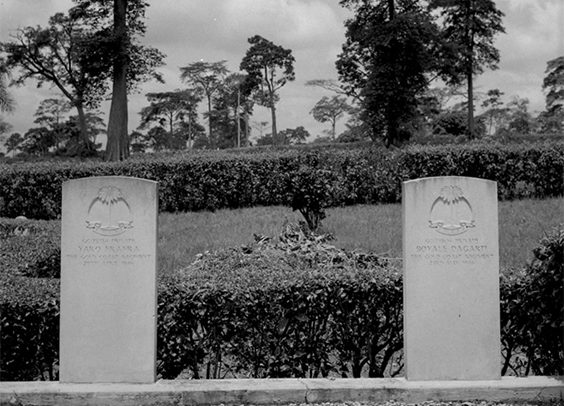
The Commonwealth War Graves Commission (CWGC) works tirelessly to preserve the legacy of the Commonwealth dead of the two world wars, which includes those from Ghana. Today, the organisation maintains 23,000 cemeteries and memorials in more than 150 countries and territories.
While many Ghanaians who lost their lives are commemorated in the countries in which they fell, such as Burma, a still sizeable number are commemorated in several cemeteries and memorials across Ghana. These include Christiansborg Civil Cemetery and Christiansborg War Cemetery in Accra, Takoradi European Public Cemetery, the Kumasi Memorial in the Ashanti region, and Kumasi Public Cemetery, known locally as the Tafo Public Cemetery.
The CWGC’s work is guided by a simple but enduring principle: those who died in service should be remembered equally and for evermore, in beautifully maintained places of commemoration. We continue to work hand-in-hand with local communities to find, protect and commemorate all the casualties of the two world wars, honouring the promise the organisation made in 1917 to ensure their names and contributions to these seismic events are remembered in perpetuity.
Source: Dr George Hay, Official Historian, Commonwealth War Graves Commission