
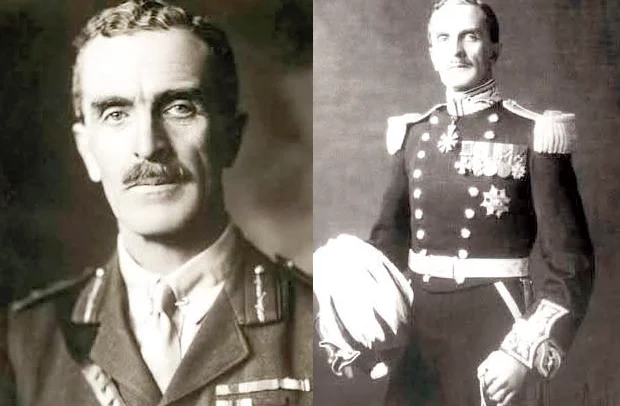
Governor Frederick Gordon Guggisberg
Many governors ruled the Gold Coast and while some of these left important footprints on the sand of the country’s history, others did not, just part of the numbers.
Brig Frederick Gordon Guggisberg was arguably the most prominent of the governors.
He was born on July 20, 1869 in Galt, Ontario, Canada, to a Swiss father and an English mother. He trained as a military engineer in Britain and served with distinction in the British Army, especially during World War I. His background in engineering and planning would later shape his approach to leadership.
He arrived in the Gold Coast (now Ghana) in 1919, shortly after the war, and served as Governor from 1919 to 1927. At the time, the colony faced serious challenges: poor roads, limited healthcare, and few opportunities for higher education for Africans. From the start, Guggisberg believed that development should improve the lives of the people, not only serve imperial interests.
Soon after taking office, he introduced a bold Ten-Year Development Plan, the first comprehensive plan of its kind in the Gold Coast. Under his leadership, major projects were launched, including the Takoradi Deep-Water Harbour, expanded roads and railways, and improved public services.
In 1923, he commissioned Korle Bu Hospital in Accra, which became the most advanced medical facility in West Africa at the time. He also strongly supported education, backing the establishment of Achimota College, which opened in 1927 and later educated many of Ghana’s future leaders.
Politically, Guggisberg introduced the 1925 Constitution, which cautiously expanded African participation in governance through provincial councils and limited elections, an important step toward political awareness and self-rule.
Sir Gordon Guggisberg left the Gold Coast in 1927 and died in 1930, but his legacy endures. Many institutions that continue to serve Ghana today trace their foundations to his tenure.
Though a colonial governor, he is remembered as one of the most development-focused administrators in Ghana’s history, judged not only by the power he held, but by what he built and left behind.
So outstanding was he that he is the only colonial governor with a statue to his memory at the façade of the Korle Bu Teaching Hospital, one of his monumental achievements.
History has it that his parents moved to a Swiss village, Guggisberg, because his father did not want to be conscripted into the Russian Army at the turn of the 18th Century.
He adopted the name of the village to conceal his identity.
The baby boy was given the name Frederick Gordon Guggisberg.
At the early age of four, he lost his father and so his mother moved to Toronto where the widow met an English Admiral Ramsey Dennis, the two eventually moving to England with the young boy.
Fate pushed him to seek refuge in the Swiss village of Guggisberg, adopting the name of the place as his surname.
Gordon Guggisberg accessed British education at the end of which he joined the military, undergoing his officers’ course at Woolwich and upon his commissioning as Second Lieutenant he was posted to the Royal Engineers at the young age of 20.
In Singapore, he served in the Malay Submarine Mining Company of the Royal Engineers until 1897 when he was posted back to England as a Fortification Geometric Drawing Instructor at the Royal Military Academy.
In 1900, he was promoted to the rank of Captain and posted to the Colonial Office, a couple of years after which he was appointed Assistant Director of Surveys, an appointment which linked him to the Gold Coast until his death in 1930.
The arrival of the Portuguese in 1471 ushered in the gold business until the third decade of the 18th Century when it was replaced by the slave trade.
In the latter part of the 18th Century, there was a renewed interest in the gold business, with prospectors pouring into the Gold Coast.
Soldiers who saw action in the Sir Garnet Woseley war or Sagrenti war spoke of abundance of gold, and thus whipping interest in prospecting for the precious stuff.
The business was unregulated, anomaly which saw government stepping in with a regulation as evidenced in the passage of the land bill.
The land bill generated protests, and government abandoned it only to return to it when anomalies such as double sale of lands and concessions and the associated challenges.
Enter the timber business in which excessive interest was showed. The colonial authority in their effort to obviate a repeat of what greeted the gold business passed a concession ordinance to regulate the natural resource and to grant acquisition of concessions in 1900.
This development required the mapping of the Gold Coast; a Survey Mapping Department was created to undertake the systematic mapping and survey of the Gold Coast.
In 1901, the then Governor of the Gold Coast, Nathan Mathew, appointed Maj Alan Watherton as Director of the new department, followed a year later with the arrival of Gordon Guggisberg as Assistant Director of the department.
Many have not wondered why the Survey Department is planted in military land in Accra. The task of mapping and surveying was undertaken by military officers during the colonial era, hence the presence of the department in the area considered Ministry of Defence land.
After holding the position for six years, Guggisberg was appointed Director when Watherton was made the Chief Commissioner for the Northern Territories.
During his tenure, the unit was relocated from Sekondi to Accra, its roles shifting from solely mines surveying to map making.
So much progress was made under him that by 1906, a complete map of the colony showing districts and its boundary with Ashanti was ready.
These were early days in the area of surveying and Guggisberg had to work with a few implements, relying on a few Africans to undertake his assignment in dense forests.
He also ate local dishes when his stock of food was depleted. He earned the respect of the locals with whom he worked, as he trained some of them to become competent surveyors.
His understanding and appreciation of local tradition was to become important assets for him when he eventually becomes Governor of the Gold Coast. He towered over his predecessors in terms of knowledge of the Gold Coast because of the various positions he held in the colony prior to his becoming governor.
In 1908, his duty tour had come to an end and he returned to England with a deserving testimonial from the Army. The Colonial Office awarded him a CMG.
His knowledge of West Africa received a further boost when he was appointed Director of Surveys of Southern Nigeria between 1910 and 1914 by the Colonial Office.
He was awaiting posting to the Gold Coast when the first Great War or World War II broke out.
He was posted to France where he was until the end of hostilities, rising to the rank of a one-star General, Brigadier in the British Army.
He succeeded Hugh Clifford in 1919, and his adversaries considered him inappropriate for the position because they thought he was not sufficiently experienced for the position. They actually looked down upon his level of education and birthplace. His achievements, which overshadowed those who regarded him as unqualified for the position of governor, would shame them in the end.
By A.R. Gomda