
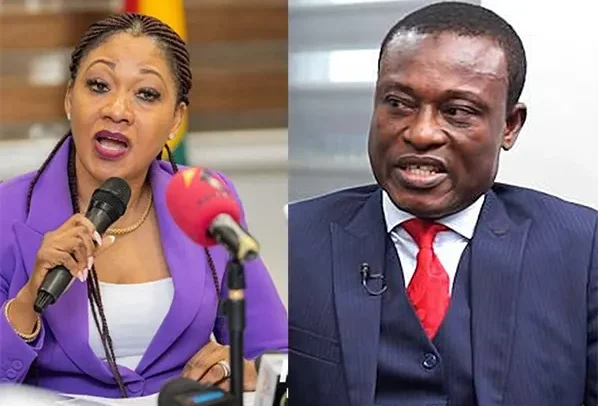
Jean Mensa and Kissi Agyebeng
Seven petitions calling for the removal of Chairperson of the Electoral Commission (EC), Jean Mensa and her two deputies, Dr. Bossman Eric Asare, in charge of Corporate Services, and Samuel Tettey, responsible for Operations, have been rejected by Chief Justice Paul Baffoe-Bonnie.
The Chief Justice (CJ) also rejected another three petitions calling for the removal of Kissi Agyebeng as the Special Prosecutor (SP).
The three petitions asking the President to remove Kissi Agyebeng as the Special Prosecutor, surfaced in the midst of several individuals calling for his removal for being ineffective.
While the petitions were pending, Mr. Agyebeng dodged a ‘political’ bullet after the President stepped in to call for the suspension to introduce a bill calling for the scrapping of the Office of the Special Prosecutor all together.
The rejection of the petitions by the Chief Justice was based on a determination that the 10 petitions did not disclose a prima facie case against the four respondents.
The decision was contained in a statement issued by the Presidency communicating the outcome of the President forwarding the petitions to the Chief Justice in accordance with Article 146 of the 1992 Constitution and Section 15 of the Office of the Special Prosecutor Act, 2017, (Act 959).
“Following the receipt of seven (7) petitions from various individuals and groups for the removal of the Chairperson of the Electoral Commission and her Deputies and three (3) petitions for the removal of the Special Prosecutor, President John Dramani Mahama, in accordance with Article 146 of the 1992 Constitution and Section 15 of the Office of the Special Prosecutor Act, 2017, (Act 959), referred same to His Lordship, Justice Paul Baffoe-Bonnie, Chief Justice, on November 25, 2025, to determine whether the petitions disclose a prima facie case,” the statement said.
It added that, “By a letter dated January 26, 2026, the Chief Justice informed His Excellency the President that no prima facie case has been established by the petitions to warrant any further investigations for the removal of the Electoral Commissioner, Deputy Commissioners and the Special Prosecutor.”
President Mahama, last December, forwarded to the Chief Justice, 10 petitions calling for the removal of the Chairperson of the Electoral Commission and her two deputies, as well as Special Prosecutor, Kissi Agyebeng.
Minister of State in charge of Government Communications, Felix Kwakye Ofosu, who confirmed receipt of the petitions at the time, indicated that they were in the hands of Justice Paul Baffoe-Bonnie, who was expected to deal with them in accordance with law.
The confirmation came just few days after news surfaced that an employee of the EC, Joseph Blankson Adumadzie, had petitioned the President to remove the EC Chair and her two deputies.
It later emerged that at the time he filed the petition, he had been interdicted for allegedly stealing equipment belonging to his employers and had been dragged to court for the offence.
Just days later, seven new petitions were sent to the Office of the President, all calling for removal of Jean Mensa and her deputies, raising eyebrows about the timing and whether they are meant to cover up the potential tainted nature of the first one.
Article 70(2) of the Constitution, empowers the President “acting on the advice of the Council of State, to appoint the Chairman, Deputy Chairmen, and other members of the Electoral Commission.”
Their removal follows the same processes outlined in Article 146 of the Constitution, the procedure for removing Justices of the Superior Courts.
In the case of the Special Prosecutor, the President must, within seven days, refer any petition calling for his removal to the Chief Justice who shall, within 30 days, determine whether there is a prima facie case.
Once prima facie is established, the Chief Justice shall within 14 days set up a committee which has a mandate similar to committees hearing petitions against the removal of heads of constitutional bodies or institutions appointed by the President.
The committee has 90 days within which to investigate the allegations and make a recommendation to the President, who is duty-bound to carry out such recommendations.
BY Gibril Abdul Razak