
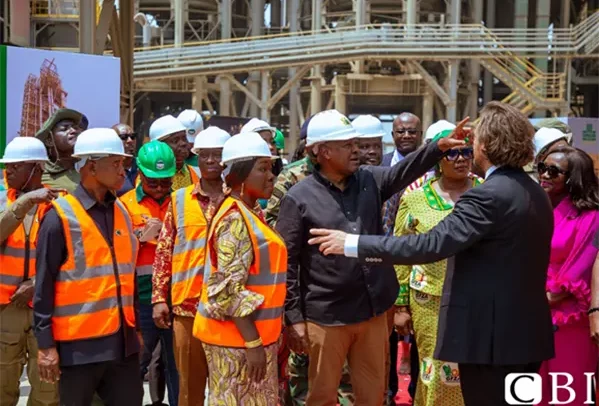
President Mahama receiving a tour of the new plant
President John Dramani Mahama has commissioned the largest calcined clay plant in the Tema Free Zones Enclave in Accra.
The facility, owned by CBI Ghana Ltd., represents a US$110 million investment that will revolutionise Ghana’s construction landscape through sustainable innovation.
BypioneeringLimestoneCalcinedClayCement(LC3)technology,CBIGhanaisreducingthe country’s dependenceonimportedclinker,ofwhichGhanaisAfrica’sleadingimporter.
This shift to locally sourced clay will help strengthen the Cedi and position the country as the global centre of excellence for green construction.
President Mahama, in his remarks said what CBI Ghana has built is a statement about the Ghanaian potential indicating that for decades, the country’s industrial growth has faced a punishing import bill that grew on a culture of exporting raw materials and importing finished goods.
“Today, we are proving that responsible African industrialisation is possible. I see the engineers, the technicians, and the laboratory staff here; Ghana’s industrial future will be built by your hands,” he said.
Managing Director of CBI Ghana Ltd, Frédéric Albrecht, said with the establishment of the plant, which is the largest in the world, the country is replacing imported clinker with locally produced calcined clay.
He said this would enable the country cut carbon emissions by up to 40%, similar to taking 80,000 cars off the road every year.
“We did not build this plant for CBI alone; we built it to inspire the cement world and ensure Ghanaian scientists lead the way in sustainable construction,” he said. “The eyes of the cement world are on Ghana as we set a new global standard for sustainable construction.”
The facility can produce 400,000 tons of calcined clay per year with advanced packing technology of up to 10 bags at a time, loading a 40-ton truck in just 25 minutes.
It will also significantly reduce clinker imports of about 400,000 tons, which is equivalent to 10 vessels per year and support domestic value chains, high-skilled job creation in labs and on the factory floor and retain important foreign exchange.
A Business Desk Report