
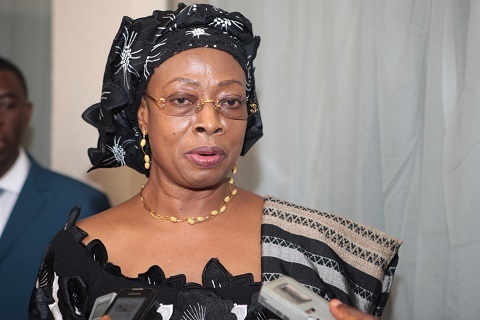
Sophia Abena Boafoa Akuffo
The Institute of Economic Affairs (IEA) has opposed Gold Fields Ghana Limited’s request for a 20-year extension of its mining lease for the Tarkwa Mine, describing the move as contrary to Ghana’s long-term economic and strategic interests.
Speaking at a press conference in Accra on Tuesday, former Chief Justice and IEA Fellow, Sophia Abena Boafoa Akuffo, called on the government to reject the application and instead pursue a framework that guarantees meaningful Ghanaian ownership and control of the Tarkwa mines.
“The IEA considers the requested lease renewal, or extension as we choose to call it, to be deeply inimical to Ghana’s long-term economic and strategic interests, and therefore calls on the government to reject it decisively,” she stated.
Her comments come after the Chief Executive Officer of Gold Fields Limited, Mike Fraser, disclosed that the company had formally applied for a 20-year extension of the lease, which expires in April 2027.
Madam Akuffo noted that Gold Fields acquired the Tarkwa Mine in 1993 and that the operation remains the largest open-pit gold mine in Africa.
According to her, the mine produces about 500,000 ounces of gold annually, valued at more than US$2.3 billion at current global prices.
She added that Gold Fields’ Ghanaian operations contribute nearly 25 percent of the company’s global gold production, which underscores the strategic importance of the Tarkwa concession to the multinational firm.
“It is therefore not surprising that the company should be deploying every available avenue, including high-level lobbying, to preserve its hold on this concession,” she said.
Madam Akuffo argued that despite more than a century of foreign exploitation of Ghana’s mineral resources under concessionary arrangements rooted in the colonial era, the country has little transformative development to show for its mineral wealth.
She said mining communities continue to suffer from poor roads, inadequate healthcare facilities, limited educational infrastructure and high youth unemployment, while the bulk of the economic benefits are transferred abroad.
“The operations of Gold Fields in Tarkwa exemplify the enduring consequences of extractive concession arrangements that overwhelmingly favour foreign investor corporations at the expense of host communities and the national economy,” she stressed.
The IEA further maintained that the impending expiration of the lease in 2027 presents Ghana with a historic opportunity to reclaim effective ownership and strategic control of the Tarkwa Mine at a time of high global gold prices.
According to the Institute, Ghana should adopt a mining model based on national ownership, responsible extraction, local value addition and the export of finished or semi-finished mineral products to maximise revenue and foreign exchange earnings.
The IEA also noted that many large-scale mining operations in Ghana are already managed by indigenous firms, including Engineers and Planners, Heath Goldfields Limited and Rockshore International Limited, proving that Ghanaian companies have the capacity to lead mining operations.
“No more concessions,” the former Chief Justice declared.
Former Speaker of Parliament, Prof. Aaron Mike Oquaye, also called on the government not to renew mining leases that fail to make national ownership a priority.
According to him the country is in a strong position to take control over key national assets once existing agreements expire.
“In many countries in the world, governments are renegotiating contracts that are still valid. Even there, people succeed in doing so.”
“In our case, we are even in a better position. There will be no renegotiation. The lease, the contract, will expire in April of next year, just a few months to go,” he stated.
The former Speaker also said that the country has failed to maximise the benefits of its Gold, Bauxite, Manganese, Diamond, Lithium, and oil resources, though the country is a major player in the mining industry.
“What we have is our Gold, Bauxite, Manganese, Diamond, Lithium among others. The way we have dealt with these natural resources determined the situation we are in today. Should we continue? he asked.
He, therefore, urged the government to prioritise local participation and national interest in managing the country’s mine for the benefit of all Ghanaians.
By Ebenezer K. Amponsah