
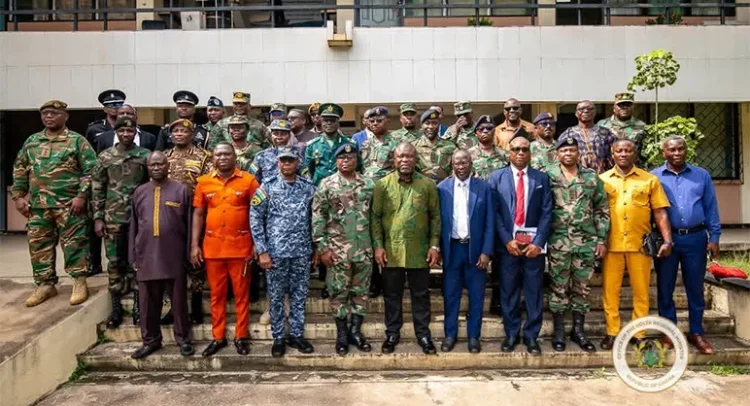
The minister in a pose with NCDS officials
The Volta Regional Minister, Mr. James Gunu, has commended media practitioners in the region for their responsible and professional reportage, describing their contribution as crucial to maintaining peace, national cohesion and security.
According to him, journalists in the Volta Region have consistently demonstrated a high sense of responsibility by avoiding sensationalism and divisive narratives that could undermine social harmony.
Mr. Gunu made the remarks on Monday when a research team from the National College of Defence Studies (NCDS) in Accra paid a courtesy call on him at the Volta Regional Coordinating Council. The team is in the region to conduct a study on the relationship between national cohesion, security and sustainable development.
“Their coverage does not compromise the cohesion and security of the region. I must put it on record that we have no reckless media in this region,” he disclosed.
He noted that by prioritising factual and contextual reporting, journalists in the region have helped prevent misunderstandings that could potentially escalate into conflict. He praised the media for playing a significant role in preserving the peace and stability the region currently enjoys.
Beyond the media’s contribution, Mr. Gunu attributed the relative peace in the Volta Region to the people’s rich cultural heritage, shared language and longstanding tradition of tolerance and coexistence.
He stated that cultural practices, particularly traditional festivals, serve as platforms for reconciliation and unity among community members.
“Culture plays a key role in uniting our communities. During traditional festivals, there are rituals where if you have something against me, we forgive each other before we go to the celebration,” he stated.
The minister further observed that the predominance of the Ewe language across the region, despite variations in dialect, has strengthened communication and fostered mutual understanding among residents.
“Language differences can sometimes hinder communication and cohesion. When you are speaking a language that I do not understand, I may think you are saying something about me. But we speak the same language – Ewe. Even though with different dialects, we understand ourselves,” he added.
Mr. Gunu also highlighted the role of intertribal marriages in promoting unity, citing his own family connections to the Anlo, Avenor and Tongu traditional areas as an example of how social integration continues to strengthen bonds among communities.
He stressed that the peace and unity enjoyed in the region are the result of deliberate collaboration among various stakeholders, including traditional authorities, security agencies, local assemblies and civil society groups.
“The peace and unity of the Volta Region are not accidental. They are the result of conscious efforts by institutions and individuals working together for the common good,” he noted.
Leading the NCDS delegation, Brigadier General Eric Konadu, Deputy Commandant of the College, explained that the Volta Region was selected for the study because of its reputation as one of the country’s most peaceful regions, despite occasional chieftaincy disputes.
He said the research seeks to identify factors that have contributed to the region’s stability and to compare the findings with similar studies being conducted in the Ashanti Region and other jurisdictions outside Ghana.
According to Brig. Gen. Konadu, the outcome of the study will inform policy recommendations aimed at strengthening national cohesion and security across the country.
“The objective is to understand how cohesion has contributed to peace and stability in the Volta Region and to translate those lessons into practical recommendations that can guide national policy,” he added.
FROM Daniel K. Orlando, Ho