
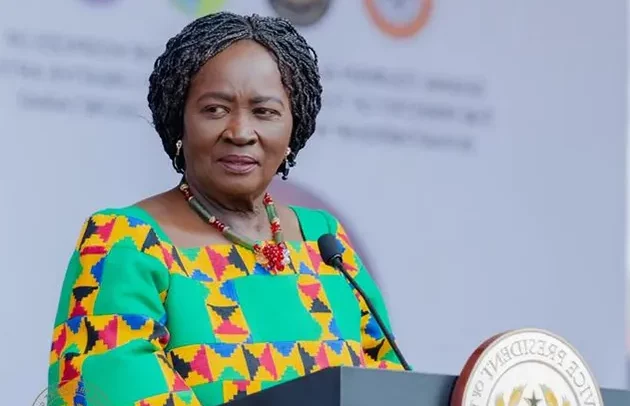
Vice President Prof. Naana Jane Opoku-Agyemang
Government will not hold major renegotiations on public sector conditions of service in 2026 as it focuses on overhauling Ghana’s national remuneration system, Vice President Professor Naana Jane Opoku-Agyemang has announced.
Speaking at the 2026 Annual National Labour Conference in Ho, the Vice President said government will instead implement “targeted and modest” adjustments to selected allowances while it completes work on a comprehensive compensation framework.
The conference, on the theme, “Strengthening Industrial Harmony as a Catalyst for Accelerated Economic Growth and National Development,” brought together government, organised labour, employers, the National Tripartite Committee, development partners and other stakeholders.
Prof. Opoku-Agyemang said successive governments had tried to improve public sector pay, but the current compensation structure is under strain and requires systemic reform.
A key part of the long-term plan, she noted, is the establishment of the Independent Emolument Commission to stabilise remuneration and strengthen institutions governing public sector pay.
“For this reason, government deliberately proposed that 2026 should not be a year for broad-based negotiations across the public sector,” she explained. “Selected allowances will receive modest adjustments as an interim measure while foundational reforms to the national emolument system are completed.”
According to the Vice President, organised labour has accepted the proposal, saying it will help manage expectations, preserve industrial peace and create the fiscal and administrative space needed to roll out the new framework. She stressed that industrial harmony is critical to sustaining Ghana’s economic recovery and development.
On pensions, she reaffirmed government’s commitment to protecting retirees. She assured contributors that statutory obligations to the Social Security and National Insurance Trust, SSNIT, and Tier Two schemes will be honoured, describing decent pensions as central to workers’ welfare.
Prof. Opoku-Agyemang also spoke on government’s proposed 24-hour economy policy. She said the initiative will encourage businesses, factories and service providers to operate multiple shifts to maximise productive capacity, create jobs, boost productivity and position Ghana as a competitive export-driven economy.
Volta Regional Minister, James Gunu, described the conference as vital for dialogue on the future of work. He said sustainable development depends on dialogue, mutual respect and collaboration among government, employers and workers. Minister for Labour, Jobs and Employment, Dr. Abdul-Rashid Hassan Pelpuo, said the labour environment has remained relatively peaceful over the past 18 months due to sustained tripartite engagement.
He cited the new Ghana Decent Work Country Programme, 2026-2030, developed with the ILO, which aims to expand productive employment, inclusive social protection and compliance with international labour standards.
Ghana Employers’ Association President, Nana Dr. Emmanuel Adu-Sarkodie, called for productivity-boosting policies and a national affordable housing programme to deliver about 1.8 million units. He argued it could create hundreds of thousands of jobs and stimulate construction and manufacturing.
By Daniel K Orlando, Ho