
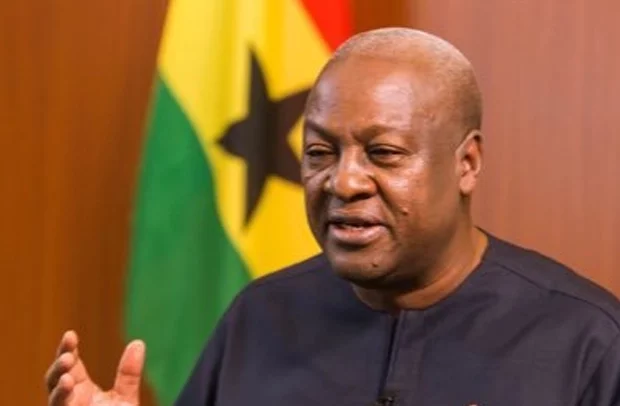
President John Mahama
The government has accepted some of the key recommendations by the Constitutional Review Committee (CRC) including extending the tenure of the President and Parliament from four years to five years.
Attorney General and Minister of Justice, Dr. Dominic Ayine, who announced this yesterday at a press briefing to explain government’s position paper on the Constitutional Review Committee report, said the proposal is intended to provide various governments more time to implement and evaluate their policies before the next election cycle.
He indicated that the current four-year electoral cycle does not provide governments sufficient time to deliver on their programmes, as the beginning and end of each administration are characterised by transition and election-related activities, arguing that a five-year term would create a more realistic timeframe for policies to be implemented.
“The government has accepted a recommendation to extend the term of office of the president from four years to five years, with the term of Parliament extended to correspond with this,” he emphasised.
He said, “Our thinking is practical. Under the current four-year cycle, the early months of every administration are consumed by transition matters, and the final year is largely consumed by elections.”
The Attorney General also mentioned that though the government had accepted the committee’s recommendation to lower the minimum age for presidential candidates from 40 to 30 years, government rather prefers 35 years.
“Still under the presidency, the committee recommended that the minimum age of eligibility for election as president be reduced from 40 years, currently in the Constitution, to 30 years. The government has accepted this recommendation in principle, subject to one modification,” he noted.
He also mentioned that the government has accepted a proposal to move the country’s presidential election to the first week of November, to help provide certainty to the country’s electoral calendar and provide adequate time for the transition to a new administration before the constitutional inauguration date of January 7.
The Attorney General explained that a fixed period will allow the commission, the parties, and observers to plan, as well as ensure there is enough interval between the election and the inauguration of the president-elect, though the specific date may be provided by the Electoral Commission subject to constitutional instrument.
He stated that any petition challenging the outcome of a presidential election should be filed within 14 days after the declaration of results and determined by the Supreme Court within 30 days.
“In other words, the Constitution will be amended to specifically provide for these timelines when it comes to the electoral petitions to be filed. And there is going to be a constitutional obligation on the part of the Electoral Commission to disclose all relevant data to the court and to all the parties.
“We take this position because the timely resolution of election disputes inures well to the stability of our democratic transitions and to the general political stability of our country and society,” he added.
The Attorney General further announced that the government has accepted the CRC’s proposal to place a constitutional cap on the size of Parliament, with the total number of Members of Parliament expected not to exceed 300.
He said the 276 Members of Parliament will continue to be elected through the existing system while 24 seats will be allocated through a proportional representation mechanism designed to increase the representation of women, persons with disabilities (PWDs) and young people.
“The government has accepted that the size of Parliament be capped and we propose a ceiling of 300 members. The current membership of Parliament is 276 and so these will be elected directly in constituency elections like we already have, and the remaining 24 will be elected or selected through proportional representation among women, persons with disabilities and the youth,” he explained.
Dr. Ayine added that an independent study will be commissioned into the design of the proportional representation system, stressing that capping the number of parliamentarians will save cost as well as open avenues for other people to join the legislature.
By Ebenezer K. Amponsah