
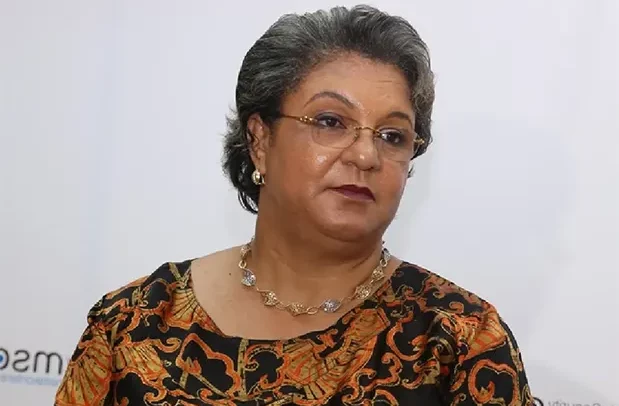
Hanna Serwaa Tetteh
United Nations (UN) Special Representative, Hanna Serwaa Tetteh, has stated that the biggest challenge facing the African continent is not the absence of policies but the failure of member states to implement decisions.
Speaking at the 21st ‘Kronti ne Akwamu’ lecture series in Accra on Wednesday, on the theme, “The Changing Global and Multilateral Rules-Based Order: Implications for Ghana and Africa’s Positioning,” the former Minister for Foreign Affairs said the continent could only strengthen its position in an era of intense geopolitical competition by translating continental decisions into action.
“The challenge is not with the Commission. It’s the challenge with member states. We don’t implement the things that we have agreed to do. And if we don’t implement the things that we have agreed to do, how do we expect anything different to happen,” she said.
She referenced a speech by the former Chairperson of the African Union (AU) Commission, Moussa Faki, who disclosed that 93 per cent of AU decisions taken between 2021 and 2023 had not been implemented, describing the trend as detrimental to the organisation’s credibility.
According to her, while the AU had demonstrated unity on symbolic and governance issues, implementation had been weak in areas involving regional security and national interests, a situation she says continues to undermine the credibility and effectiveness of the continental body.
She, however, welcomed the AU Assembly’s decision in February this year to develop a Common African Foreign Policy Framework by 2027, adding that it acknowledged many of the challenges confronting the continent, but cautioned against adopting an overly ambitious framework with little prospect of implementation.
“My suggestion is to focus on a couple of core objectives where perhaps we can agree to work together to advance the continent’s position, and not develop a foreign policy priority that aspires to be all things to all people,” she added.
The Special Representative also stressed that stronger regional cooperation would improve implementation, arguing that decisions taken by Regional Economic Communities (RECs) often enjoyed greater ownership among member states.
“The decisions that are taken at the level of the RECs, that reinforce the decisions of the African Union and support their implementation, are the things that help to make the AU more effective,” she pointed out.
She identified the effective implementation of the African Continental Free Trade Area (AfCFTA) as a priority, saying ratifying agreements alone would not transform African economies. “Agreements won’t implement themselves. There’s a difference between market access and market readiness,” she added.
Madam Tetteh further indicated that as multilateralism weakens and great power rivalry intensifies, Africa’s influence would depend less on adopting resolutions and more on implementing them through stronger institutions, regional cooperation and sustained political will.
“I will suggest that we benchmark progress on implementation with the World Balanced Logistics Performance Index. Now, I know many of you have heard about the Equity Business Indicators, which at the point in time was what we all measured our performance by.
“And I know you’ve heard the World Economic Performance Global Competitiveness Index. But the Logistics Performance Index is more relevant. It looks at the issues relating to trade facilities. How quickly can you actually clear goods to a particular country, how efficient are the institutions in supporting trade and how well they are able to function,” she added.
The Centre for Democratic Development (CDD)’s annual public lecture on democracy and governance ‘Kronti ne Akwamu‘ lecture series brought together some government officials, members of the academia, members of the diplomatic corps and several other dignitaries.
By Ebenezer K. Amponsah