
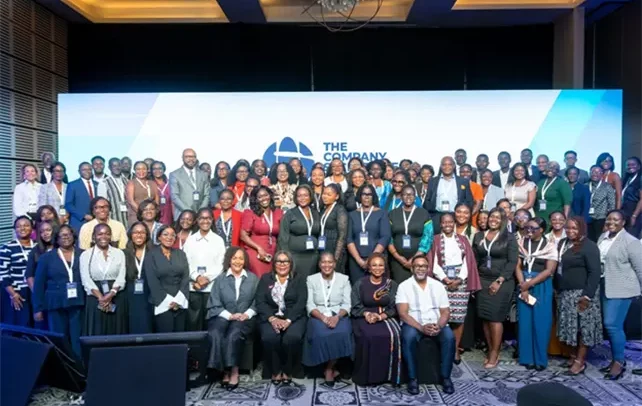
Summit delegates in a group photograph
Mindful Governance has successfully convened the maiden edition of the Company Secretaries’ Summit, a full-day premium gathering that brought together company secretaries, legal counsel, board directors and senior governance professionals from across Ghana’s public, private and state-owned sectors.
Held at the Labadi Beach Hotel in Accra under the theme, ‘Governance as Value Creation’, the summit was designed to elevate the standing of a profession that sits at the very centre of corporate decision-making, yet has long operated without a dedicated national platform of its own.
“The company secretary sits between the board, management and stakeholders, and sets the conditions in which the most consequential decisions get made, from what reaches the agenda to when it arrives there. That is the level at which these professionals operate, and the summit was built to match it. We brought board directors into the room as well, because the relationship between a board and its company secretary does a great deal to determine whether an organisation succeeds or fails, and the two sides rarely get a setting where they can speak candidly about it,” said Catherine Engmann, Founder and Managing Director of Mindful Governance.
The morning plenary opened with remarks from The Registrar of Companies, Maame Samma Peprah, Esq., who stated that while artificial intelligence can strengthen compliance monitoring, board administration and regulatory analysis, it cannot replace the professional judgement, ethical leadership and independence that define the company secretary’s role.
“As organisations adopt new tools such as artificial intelligence, strong governance frameworks will be critical to ensuring innovation is responsible and value-creating,” she said.
Effective corporate governance, the Registrar said, is a competitive advantage in attracting investment, not merely a legal obligation.
Founder and Chief Executive Officer of Governance AI, Karl George, MBE, led delegates through a working session on artificial intelligence and its implications for the boardroom.
Mr. George introduced the ‘three A’s’ of AI adoption — automation, augmentation and agency — and issued a pointed warning on ‘shadow AI’, the use of unapproved AI tools by employees on personal devices, which he described as one of the most urgent and least understood risks facing organisations today.
“Boards cannot effectively govern technologies they do not understand. Building AI literacy among directors and governance professionals is now essential to responsible decision-making,” he noted.
He urged governance professionals to raise their own AI literacy, arguing that boards cannot responsibly oversee technology they do not understand.
For her part Charlotte Kesson-Smith Osei, Esq., Chief Executive Officer of Cyrus Law, challenged the long-held view of governance as a compliance burden.
Governance, she told delegates, is not a handbrake on the organisation but a steering wheel, the mechanism that allows a business to move quickly, navigate difficult corners and arrive safely at its destination.
“The greatest value of governance lies in creating environments where the right questions are asked, difficult conversations are encouraged and organisations are able to make decisions that stand the test of time,” she said.
She cautioned that at the root of almost every major corporate failure is a boardroom in which protective voices were silenced, ignored or absent.
Ms. Engmann facilitated the Board Dynamics Mastery plenary, which used the Contribution Compass framework to examine how the differing behavioural profiles around a board table shape the way directors work together.
A Guide Report