
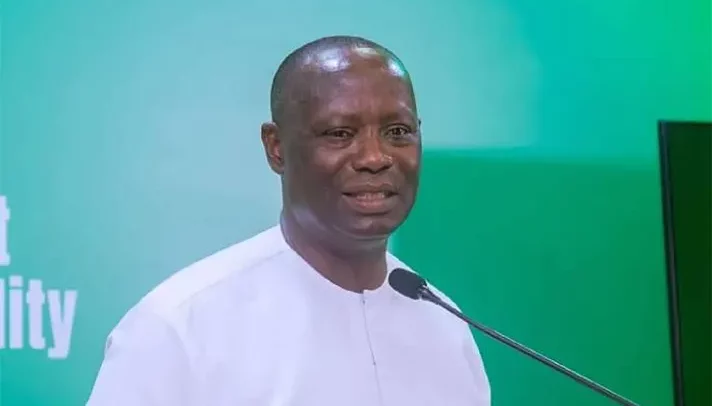
Emmanuel Armah-Kofi Buah
The revocation of Adamus Resources Limited’s mining lease is about more than illegal mining.
An Inter-Ministerial Review Committee confirmed the Minerals Commissions investigative findings of a trail of unpaid taxes, questionable money transfers and mismatched gold records that raise serious questions about how much revenue Ghana lost while the company operated in the Western Region.
The committee, set up by Lands and Natural Resources Minister Emmanuel Armah-Kofi Buah and chaired by Prof. Jerry Samuel Yaw Kuma, was tasked with reviewing Adamus’ petition against the cancellation of its Nkroful, Akango and Salman leases.
Its findings point to what it describes as “deliberate non-compliance” rather than temporary cash problems.
According to the report, Adamus Resources owed the state approximately GH¢205.83 million plus US$2.56 million as of the review period.
The company was also in arrears of GH¢86.78 million in royalties payable to the Minerals Income Investment Fund (MIIF), dating back to 2020.
It also owed GH¢119.04 million in taxes to the Ghana Revenue Authority (GRA), from 2023. In addition, US$2.56 million in annual payments to the Minerals Commission remained unpaid.
The problem, the committee says, deepens when those arrears are placed next to the company’s internal money movements.
A review of Adamus’ financial statements by the committee showed the company transferred more than US$224.61 million to related parties between 2020 and 2024. About US$123.14 million of that went to Segala Mining Corporation SA, Semico 1 and Semico 2 in Mali.
The committee rejected the claim that statutory payments were missed because of a lack of cash. “The evidence points to deliberate non-compliance,” it concluded, noting the transfers happened while debts to the state were already mounting.
The confusion extends across state institutions. For the period 2024 to January-March 2026, Adamus reported 72,194.94 ounces to GRA. It reported 71,553 ounces to the Minerals Commission. However, its shipment records show 74,375.14 ounces. The committee flagged two other variances worth about US$12.02 million and US$21.30 million.
Environmental compliance also came under scrutiny as two Environmental Protection Authority (EPA) permits show backdated timelines.
“Permit EPA/EMP/313 for Salman covered July 20, 2017 to July 19, 2020. But it was only issued on December 19, 2024, more than four years after it expired. Permit EPA/EMP/316 for the Nzema operation ran from December 21, 2023 to December 20, 2026,” the committee said.
It was issued on December 16, 2024, almost a year after operations under it had begun. Both certificates came out in the same week, and in reverse order.
Given the scale of breaches, the committee recommended that the revocation of Adamus’ leases be upheld. It also called for stronger regulatory, environmental and financial enforcement, including a comprehensive audit of the company’s activities.
For Ghana, the stakes are high. Every ounce unaccounted for is revenue lost. Every cedi unpaid is a school, clinic or road that may not be built.
As the government weighs next steps, the Adamus case is likely to reignite debate about oversight in the mining sector, the power of related-party transactions, and whether Ghana’s systems are strong enough to ensure the country gets its fair share from its gold.
The Lands Ministry says it will study the committee’s recommendations and announce enforcement actions in due course.
A Daily Guide Report