
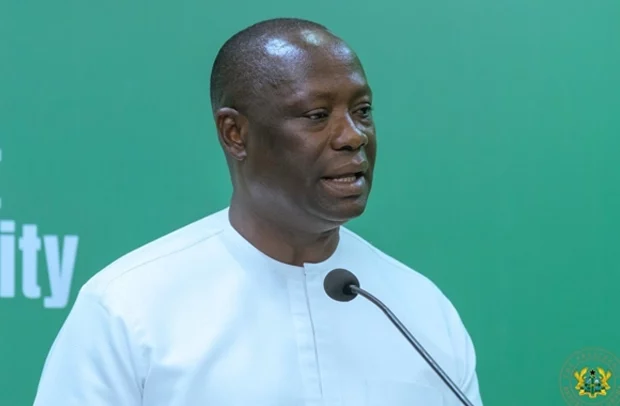
Emmanuel Armah-Kofi Buah
The Omanhene of the Eastern Nzema Traditional Area and President of the Eastern Nzema Traditional Council, Awulae Amihere Kpanyinli III, has accused the Member of Parliament (MP) for Ellembelle and Minister for Lands and Natural Resources, Emmanuel Armah-Kofi Buah, of “crossing the red line” in an ongoing chieftaincy dispute in the area.
According to the Omanhene, the minister’s actions and public appearances have created the impression that he has taken sides in the dispute over the legitimate Paramount Chief of the Eastern Nzema Traditional Area.
In a statement, Awulae Amihere Kpanyinli III said the situation was no longer simply a disagreement between competing traditional actors, but had increasingly become a question of whether political power was being brought to bear on a traditional institution whose legitimacy should be determined by customary law, the Constitution and the appropriate chieftaincy institutions.
He said such legitimacy should not be determined by politicians, government events, public appearances or the influence of state officials.
Awulae Amihere Kpanyinli III stressed that the Eastern Nzema Traditional Area was not a creation of modern partisan politics and predated the modern electoral constituency.
“The office of a Paramount Chief is not created by a Member of Parliament, a District Chief Executive, a Regional Minister or a Cabinet Minister,” he said.
He added that representing people within an electoral constituency did not make an MP the traditional authority over them.
“His position as MP does not confer upon him the power to determine who is Omanhene. His position as Minister for Lands and Natural Resources does not confer that power either. And no political office should be used, directly or indirectly, to create the impression that it does. That distinction is fundamental,” he stated.
One of the incidents that had generated concern, the Omanhene recalled, was the appearance of the minister on a public banner for last year’s Kundum alongside a person whom his side disputes as the legitimate Paramount Chief of Eastern Nzema.
He said while such an appearance might ordinarily have little significance, the circumstances surrounding the chieftaincy dispute made it important.
“Where there is an unresolved dispute over traditional legitimacy, the public appearance of a senior Cabinet Minister alongside one claimant can reasonably be interpreted as an act of recognition or political endorsement,” he explained.
He said lawyers acting for him had already written to the minister and cautioned him about his involvement in the matter, particularly after his photograph was featured on a banner as the special guest of honour for the 2025 Kundum celebration.
Another incident that, he said, deserved public scrutiny was the alleged presentation of the disputed claimant as Omanhene during the National Democratic Congress (NDC) National Chairman’s thank you tour.
“This is particularly significant because it allegedly involved a Member of Parliament and a District Chief Executive presenting the person to a senior national political official in the capacity of Omanhene. That is not a minor detail,” he stated.
The Omanhene further argued that political interference did not always take the form of a formal letter, but could occur through public photographs, banners, invitations to official meetings and the handling of government delegations.
He said it could also manifest through who was introduced to national political leaders, who was excluded from engagements and the silence of public officials when a disputed narrative was repeatedly presented as fact.
“When these things happen repeatedly, they can gradually create a new public reality,” he said.
On the Adamus mining controversy, the Omanhene questioned which traditional authority the minister was engaging with and the basis for such engagement.
Assassination Attempt
The Omanhene also recalled an alleged assassination attempt on his life at his palace in early 2025, which resulted in his absence from the palace and, in his words, an abandonment of his traditional office.
He said state security considerations subsequently created circumstances in which another person occupied the palace, but cautioned that the development should not automatically be interpreted as a determination of traditional legitimacy.
He took exception to what he described as a lack of empathy from the minister when his life was threatened, while accusing the minister’s subsequent public appearances of creating the impression of support for a disputed claimant.
Awulae Amihere Kpanyinli III said his position was not that politicians should stay away from Eastern Nzema.
Rather, he said, he expected government to intervene in addressing development challenges in the area, including roads, schools and other infrastructure.
He, however, warned the minister and other political actors against treating Nzema as a “pilot ground for political experimentation in chieftaincy.”