
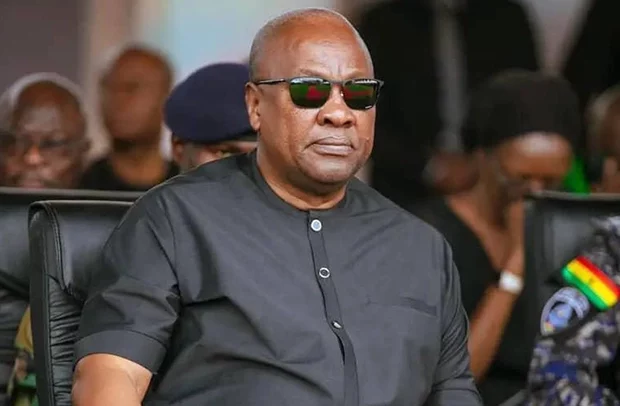
President John Mahama
The Education Sector Policy Committee of the New Patriotic Party (NPP) has challenged President John Mahama to either apologise to Ghanaians or sack the Minister of Education, Haruna Iddrisu, over the controversy surrounding the proposed introduction of Arabic and Chinese languages into schools.
The committee said if the Education Minister announced and pursued the policy without presidential or Cabinet approval, then the President should relieve him of his position.
However, if the minister acted with the knowledge or authority of the President or Cabinet, it said President Mahama must apologise to the Ghanaian public for denying a policy that his government had already set in motion.
In a statement released yesterday, the committee said the President’s recent declaration that there was “absolutely no new policy” on the introduction of Arabic and Chinese had created a serious contradiction, particularly in view of earlier actions by the Education Ministry and its agencies.
It recalled that on April 24, 2026, Mr. Iddrisu publicly announced that Chinese and Arabic would become compulsory foreign languages at the secondary school level and linked the policy to President Mahama’s vision for education.
According to the committee, the Ministry subsequently instructed the National Council for Curriculum and Assessment (NaCCA) to undertake curriculum development work, involving about 160 writers and reviewers over several months.
It said a revised curriculum incorporating Arabic and Chinese among foreign-language options was presented to the Education Minister on July 22, 2026.
The committee claimed that instead of rejecting the curriculum, the minister referred it to the Ghana Education Service (GES) and directed the service to bring it to “full implementation readiness”, take early ownership and prepare for classroom implementation.
It further cited the training of teachers by NaCCA on September 3, 2026, with support from the Confucius Institute at the University of Cape Coast, as evidence that preparations had progressed beyond a mere proposal.
The NPP committee said the sequence of events would reasonably lead the public to believe that the policy had been authorised by the government, particularly because the Education Minister had attributed the policy direction to the President.
It therefore questioned the President’s subsequent assertion that there was “absolutely no new policy”, arguing that the statement had failed to explain the actions already taken by the Ministry, NaCCA and GES.
The committee also raised questions about public expenditure associated with the process, including curriculum development, workshops, technical work and teacher training.
“If there was ‘absolutely no new policy’, why were public resources committed to developing the curricula, preparing the system for implementation and training teachers?” it asked.
The committee also pointed to President Mahama’s concern about the availability of Chinese language teachers, particularly when Ghana was already experiencing shortages of French teachers.
It questioned why the implementation process had progressed to curriculum development and teacher training if teacher availability remained unresolved.
The NPP, however, distinguished between Arabic and Chinese, noting that Arabic had existed as an optional subject at the Junior High School level before the current government assumed office.
Chinese, it said, was different, because the 2026 process involved curriculum development, consideration by the Education Ministry, preparations by GES and teacher training.
The committee said the controversy had broader implications for government policy coordination and accountability.
It argued that if a minister could announce a major policy, attribute it to the President, involve government institutions and commit public resources to its development without the required approval, questions would arise about how other government decisions were being taken.
The committee said parents, teachers, school administrators and taxpayers deserved clear and consistent communication from the government.
It maintained that the controversy could not simply be declared settled, and repeated its call for President Mahama to either apologise to the nation and provide a full account of the policy and expenditure involved, or sack the Education Minister for acting without the necessary authority.
A Daily Guide Report