
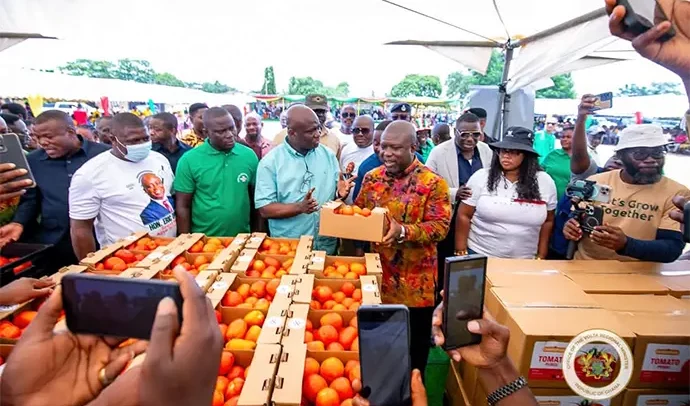
The Volta Regional Minister and Agriculture Minister with some tomato farmers
The Volta Regional Minister, James Gunu, has called on the government to establish a tomato processing factory in the Volta Region to reduce post-harvest losses, create jobs and add value to tomato production under the Ghana Tomatoes Self-Sufficiency Initiative (GHATSI).
He said the proposed factory, together with irrigation, improved farm inputs, affordable financing, insurance and guaranteed off-take arrangements, would make tomato farming more profitable and attractive to farmers in the region.
Mr. Gunu made the call when the Ghana Tomatoes Self-Sufficiency Initiative was launched at Anlo Senior High School Park, Anloga, describing the initiative as a timely intervention capable of transforming tomato farming into a more profitable and predictable agricultural venture while reducing Ghana’s dependence on imported tomatoes and tomato-based products.
He commended President John Dramani Mahama and the Minister for Food and Agriculture, Eric Opoku, for what he described as significant investments in agriculture in the Volta Region. He disclosed that more than 20,000 bags of fertiliser were distributed to farmers in the region last year, while 1,500 bags had been allocated to each of the region’s 18 District Assemblies this year.
According to Mr. Gunu, the region had also received 180,000 birds under a poultry support programme through the government’s Feed Ghana initiative. He added that two of the 10 Farmer Service Centres being constructed nationwide this year were being established in the Volta Region, reflecting the region’s potential to contribute significantly to Ghana’s agricultural development.
Touching on irrigation, the Regional Minister said government was working to construct two new irrigation dams at Have and Kpando Aziave. He further disclosed that plans were underway to rehabilitate 22 existing but deteriorating irrigation dams across the region from next year to support year-round farming and improve agricultural productivity.
Mr. Gunu said recent reports that Burkina Faso had suspended tomato imports from Ghana should not only be seen as a setback but also as a challenge and opportunity for the country to accelerate efforts towards tomato self-sufficiency. He noted that Ghana had adequate land, water resources, favourable climatic conditions and a hardworking farming population capable of producing enough tomatoes to satisfy domestic demand.
The minister observed that despite Ghana’s agricultural potential, the country continued to spend hundreds of millions of dollars annually on tomato imports. He said GHATSI offered an opportunity to reverse the trend, identifying Anloga, Keta, Akatsi North and Agotime-Ziope as some of the major tomato-producing areas in the Volta Region that could contribute substantially to the national programme.
He welcomed the initiative’s focus on irrigation, improved farm inputs, technical assistance, financing, insurance and guaranteed off-take arrangements, saying the measures would help reduce the risks associated with tomato farming. He said the interventions could also encourage more young people and other prospective farmers to venture into tomato production as a viable economic activity.
Mr. Gunu therefore appealed to the Minister of Food and Agriculture to expand GHATSI to cover more tomato-growing communities in the Volta Region and consider establishing a tomato processing facility in the region. He said the factory would provide a ready market for farmers, minimise post-harvest losses, create employment opportunities and enable producers to derive greater value from their crops.
Farmer unions in the area expressed appreciation for the initiative and called for stronger collaboration among government, farmers, processors, financial institutions and other stakeholders to ensure its success. Mr. Gunu urged all stakeholders to work together to make Ghana self-sufficient in tomato production and ultimately position the country to produce enough for export.
FROM Daniel K. Orlando