
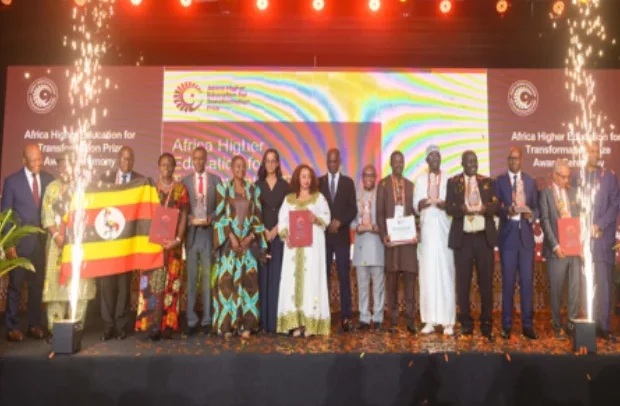
A scene during the event
Mastercard Foundation Hosts Inaugural Higher Education Transformation Convening In AccraLeaders from Africa’s higher education institutions, the African Union, government ministries, global and regional financial institutions, industry partners and young people gathered in Accra for the inaugural Higher Education Transformation Convening hosted by the Mastercard Foundation.
Held under the theme, “Reimagining Higher Education for Africa’s Human Capital Development,” the convening explored what a relevant, high-quality, impactful and sustainable higher education system should deliver for Africa’s young people.
The convening also marked the first Africa Higher Education for Transformation (AHEFT) Prize award ceremony, recognizing institutions advancing sustained, institution-wide transformation.
Speaking at the event, President and CEO of the Mastercard Foundation, Sewit Ahderom, said transformation goes beyond building a better university.
“Transformation is not just a better university. It is a university that makes the whole economy around it work better for young people,” she said.”Four things make that real. Curricula built with employers, so that what is taught is what the country needs, and learning leads somewhere. Credentials that say what a graduate can do, not how long they sat, and that travel with them across borders.”
“Institutions where young people learn to lead the technologies reshaping our economies, not merely operate them. And research that leaves the campus, into industry, into government, into the community, and comes back as enterprise and employment,” she added.
Throughout the convening, participants explored the shifts needed for universities to become engines of discovery and problem-solving, preparing young people to shape emerging technologies and ensuring research moves beyond campus to inform industry, strengthen communities and contribute to Africa’s development priorities.
Discussions also emphasised the importance of focusing research, innovation and skills development in areas where Africa has strategic comparative advantage, while strengthening private sector partnerships to align talent development and applied research with evolving workforce needs.
Young people at the convening called for their experiences and aspirations to be reflected in decisions on education, work and opportunity, and for them to be active partners in shaping the systems that affect their lives.
Executive Director for Higher Education and Strategic Initiatives at the Mastercard Foundation, Dr. John Nkengasong, said higher education transformation is an economic imperative.
“Africa’s young and growing population presents one of the world’s greatest opportunities. Realizing that opportunity will depend on higher education institutions that can develop and retain talent, drive innovation, and create stronger pathways to dignified and fulfilling work,” he said.
“Higher education transformation is not simply an education agenda. It is an economic imperative. It requires us to rethink education as a strategic investment and bring together governments, universities, industry, investors, and partners to build the systems that enable young people and economies to thrive.”
The discussions align with the African Union’s Decade of Education and Skills Development (2025–2034), which calls for stronger education systems, improved learning outcomes and skills development aligned with Agenda 2063.
Director of the African Union Department of Education, Science, Technology and Innovation, Professor Saidou Madougou, said higher education must be seen as a strategic investment.
“The African Union’s Decade of Education calls on us to view higher education as a strategic investment in Africa’s future. With higher education spending averaging less than 0.8 percent of GDP and research and development receiving less than 0.5 percent of national budgets, we must strengthen collaboration across our universities, expand faculty and student mobility, and build systems that enable talent, knowledge, and innovation to flow across borders,” he said.
Five Universities Win Maiden AHEFT Prize
The convening marked the award ceremony for the AHEFT Prize, a first-of-its-kind annual award recognizing institutions advancing sustained, institution-wide change.
The prize highlights practical examples of how universities are strengthening teaching and learning, research and innovation, student transitions to employment and health outcomes.
The 2026 laureates are Addis Ababa University (Ethiopia), the International Institute for Water and Environmental Engineering (Burkina Faso), Kwame Nkrumah University of Science and Technology (Ghana), Muni University (Uganda), and the University of Rwanda.
Backed by a USD 500 million commitment, the prize will recognize at least 150 institutions across Africa over the next decade. Each winning institution will receive USD 3 million to scale transformative initiatives.
Chair of the AHEFT Jury, Susan Chomba, said the inaugural laureates distinguished themselves through ambitious and context-grounded approaches.
“Across the applications, we saw a strong appetite for change and institutions rethinking everything from how students learn and prepare for the world of work, to how universities engage with industry, strengthen research and innovation, and respond to local challenges,” she said.
Applications for the 2027 AHEFT Prize cycle will open later this year.
The discussions in Accra underscored that no single sector can deliver transformation alone, with stakeholders called upon to identify system-level shifts they can collectively advance by 2028 to strengthen connections between education, employment, research and investment.
A Daily Guide Report