
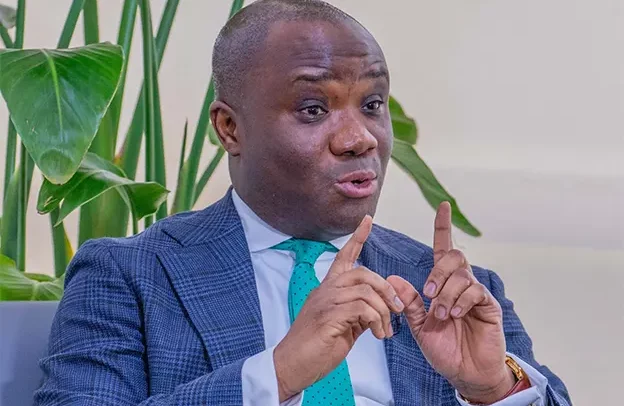
Felix Kwakye Ofosu
President John Dramani Mahama has no intention of removing the Chairperson of the Electoral Commission (EC), Jean Mensa, unless compelling evidence of serious wrongdoing is established, Minister of Government Communications, Felix Kwakye Ofosu, has stated.
According to him, no basis has been established for her removal, and stressed that the President was not inclined to remove heads of constitutional or independent institutions for partisan reasons.
“As far as President Mahama is concerned, no basis has been established for the removal of Jean Mensa. I can also assure you that he has no appetite to do such a thing unless there is absolutely compelling and serious evidence of wrongdoing against her or any other person that requires a certain course of action,” the minister told Accra-based TV3.
He added that he was not aware of any evidence of serious wrongdoing that had emerged to warrant such action.
“I’m not aware of any such evidence that has come to light,” he said, while indicating that he might have to check with the President’s secretary to establish whether any further information had been received since the initial petition was dismissed.
Mr. Kwakye Ofosu maintained that President Mahama was not inclined to take decisions against public officials purely on partisan considerations, citing the President’s handling of regulatory actions against media organisations and his position on the Office of the Special Prosecutor (OSP).
He recounted that the President had summoned him after learning that the National Communications Authority (NCA) had revoked the authorisations of several radio stations, as well as some television stations, over various regulatory violations.
According to him, President Mahama instructed him to issue a statement after contacting the NCA and the Minister for Communications to express his displeasure with the conduct that had led to the revocations.
The minister said the President’s intervention was significant because the previous New Patriotic Party (NPP) administration had closed down Radio Gold and Montie FM, which were perceived to be sympathetic to the National Democratic Congress (NDC), over alleged regulatory breaches.
He said the closures had deprived the two stations of the opportunity to participate in public discussions during an entire electoral cycle.
Kwakye Ofosu said some people within the current government had suggested that the affected stations should face similar treatment as a form of retaliation for the earlier closures.
However, he said President Mahama rejected that approach and directed that the affected stations be given one month to regularise their authorisations.
According to him, several stations complied with the directive, although some that failed to do so could not be assisted.
The minister said the episode demonstrated the President’s willingness to act against perceived partisan interests when he considered it necessary to uphold fairness.
He also cited the President’s intervention when a bill was introduced in Parliament to scrap the Office of the Special Prosecutor (OSP).
The minister said he was in Parliament when the then Majority Leader, Mahama Ayariga, and the Majority Chief Whip, Rockson-Nelson Dafeamekpor, introduced the bill.
He said President Mahama, upon learning of the move, called him and asked him to hand the phone to the Majority Leader, to whom he communicated his opposition to the proposed abolition of the office.
He stated that the governing NDC had the numbers in Parliament to pass the bill but the President opposed the move, arguing that the OSP was a relatively young institution that needed time to improve its performance.
The minister said the President subsequently made his position public, acknowledging the institution’s shortcomings while arguing that it should not be expected to operate with the same level of efficiency as institutions that had existed for decades.
Mr. Kwakye Ofosu said the then Majority Leader and Chief Whip withdrew the bill following the President’s intervention, adding that the Special Prosecutor had publicly commended the President for his stance.
He rejected suggestions that diplomatic pressure had influenced the President’s position, insisting that President Mahama acted independently in the interest of the country.
By Ernest Kofi Adu