
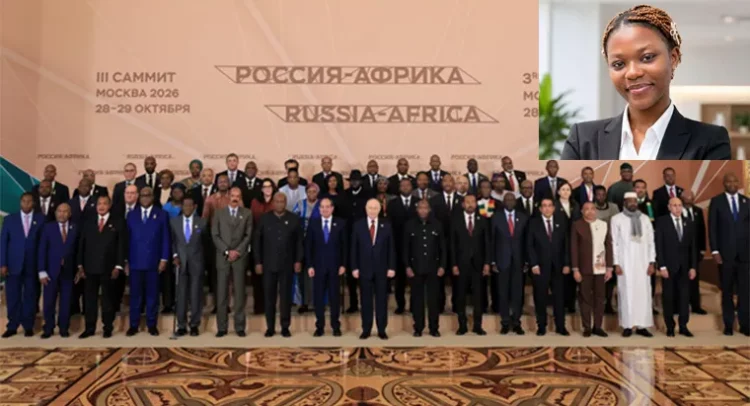
A group picture of African presidents and Russian President, Vladimir Putin. INSET: The writer
As Russia courts African governments with promises of security, investment and solidarity, the continent must learn from history and ensure that new partnerships serve its people, not merely its political elites.
As African leaders gather in Moscow for the third Russia–Africa Summit on October 28 and 29, the language of friendship, sovereignty and mutually beneficial cooperation will once again take centre stage. Yet beneath the diplomatic courtesies lies a question the continent cannot afford to ignore: when does a strategic partnership strengthen a country’s independence, and when does it quietly compromise it?
The answer matters because Africa has encountered this dilemma before. Foreign powers have repeatedly presented themselves as partners in liberation, development or security, only for their strategic ambitions to complicate the very independence they professed to support. Russia’s growing presence on the continent demands scrutiny through this historical lens.
The Soviet Union’s contribution to Africa’s liberation struggles should not be dismissed. Moscow provided political backing, military assistance and educational opportunities to movements and governments confronting colonialism and apartheid. Its support helped some African countries train professionals, establish industries and resist minority rule. That legacy remains significant.
But historical gratitude must not become a blank cheque for contemporary policy
During the Cold War, Africa became an arena for competition between the Soviet Union and Western powers. Angola’s post-independence civil war drew in Soviet weapons, Cuban troops, South African intervention and American support for rival forces. Mozambique, Ethiopia and other countries also experienced the consequences of conflicts in which domestic political struggles became entangled with wider geopolitical ambitions.
These wars cannot be reduced to foreign interference alone. African political movements and governments had their own interests, agency and responsibilities. Nevertheless, the period demonstrated how external powers could intensify conflicts, arm competing parties and turn African territories into theatres of strategic competition.
The lesson is not that foreign partnerships are inherently harmful. It is that solidarity between governments does not necessarily mean their interests are identical. Today’s Russia is not the Soviet Union, and the geopolitical circumstances have changed. Yet some features of Moscow’s contemporary engagement with Africa warrant concern. In parts of the Sahel and Central Africa, Russian security assistance has become intertwined with political relationships, commercial interests and access to natural resources.
A group picture of African presidents and Russian President, Vladimir Putin
Research by the “Carnegie Endowment for International Peace” (https://carnegieendowment.org/research/2026/02/russia-role-west-southern-africa-junta-wagner-africa-corps) describes a transactional model in which security support for selected governments has been accompanied by opaque mining arrangements and efforts to secure privileged access to minerals.
Following the demise of the Wagner Group’s founder, Yevgeny Prigozhin, Moscow has brought much of its African security activity under more direct state control through the Africa Corps and associated networks.
The implications are especially visible in Mali and the Central African Republic, where Russian personnel have helped governments fight armed opponents but have also been implicated in serious allegations of human rights abuses.
In July this year, Human Rights Watch reported that Russia’s Africa Corps had carried out airstrikes in central Mali that killed eight civilians, including three children. The organisation described the attack as apparently unlawful and called for an investigation. Such allegations underline the danger of security partnerships in which operational assistance is not matched by effective accountability.
There is a further concern. Where foreign security providers enjoy privileged access to political leaders and operate alongside opaque commercial networks, the interests of the state can become difficult to distinguish from those of the governing elite.
A government may receive assistance that helps it survive an immediate security crisis, while its citizens continue to face insecurity, weak institutions and limited opportunities to hold those responsible for abuses accountable.
The question, therefore, is not simply whether Russian forces can help a government recover territory. It is whether their presence leaves the country more secure, more institutionally capable and better equipped to govern itself when the foreign partner eventually departs.
Africa must also be wary of the economics of strategic dependence. Mineral wealth, particularly gold, has figured prominently in investigations of Wagner-linked commercial networks in the Central African Republic and Sudan. Such arrangements raise questions about transparency, royalties, beneficial ownership and the distribution of returns from natural resources.
Foreign investment can contribute to development, and security assistance can be necessary where states face armed insurgencies. But neither should provide cover for agreements that weaken public revenue, circumvent oversight or concentrate the benefits of national resources in the hands of politically connected individuals.
Nor is Russia’s influence confined to minerals and military deployments. Research by the Africa Center for Strategic Studies has documented Russian-linked disinformation operations and attempts to shape political narratives across the continent.
More recently, the recruitment of Africans through allegedly deceptive employment and educational offers for Russia’s war against Ukraine has exposed another troubling dimension of the relationship.
These developments should matter to African governments because sovereignty is not merely the freedom to choose a foreign ally. It is also the capacity to protect citizens, scrutinise contracts, enforce domestic law and change course when an arrangement ceases to serve the national interest.
None of this requires Africa to abandon Russia or substitute one external dependency for another. Western governments and companies have their own histories of intervention, unequal commercial arrangements and support for political elites. The answer is not to grant any foreign power privileged moral standing, but to apply consistent standards to all.
For Ghana, that means approaching the Moscow summit with clear economic and diplomatic objectives. Cooperation in agriculture, energy, manufacturing, technology and education could offer meaningful benefits. But agreements should be assessed against their financing terms, employment effects, technology-transfer provisions, contribution to domestic production and capacity to generate sustainable export earnings.
Security cooperation must be judged by similarly concrete measures, including civilian protection, respect for national institutions and the development of capable domestic forces. Major agreements should receive appropriate scrutiny, and their implementation should be transparent enough for citizens to evaluate the returns.
The African Union has repeatedly affirmed the principles of sovereign equality, non-interference and mutually beneficial cooperation in its relations with Russia.
The forthcoming summit offers an opportunity to give those principles practical meaning through stronger safeguards against deceptive recruitment, opaque resource deals and abuses by foreign security personnel.
Ultimately, Africa’s challenge is not to choose between Moscow and Western capitals. It is to ensure that no external relationship becomes so indispensable that national leaders can no longer insist on fair terms or accountability.
History shows that a powerful ally may help a country confront an immediate threat while simultaneously pursuing interests that do not fully coincide with its long-term development. African leadership must recognise that distinction before the costs become irreversible.
The Moscow summit should therefore be measured not by the warmth of its declarations or the number of agreements announced, but by what those agreements deliver to African citizens and what safeguards accompany them. Africa’s independence will mean little if the continent merely exchanges one patron for another. True sovereignty lies in the ability to choose partners freely, negotiate on fair terms and hold them accountable when they fail to honour their obligations.
By Gladys Opoku Anning