
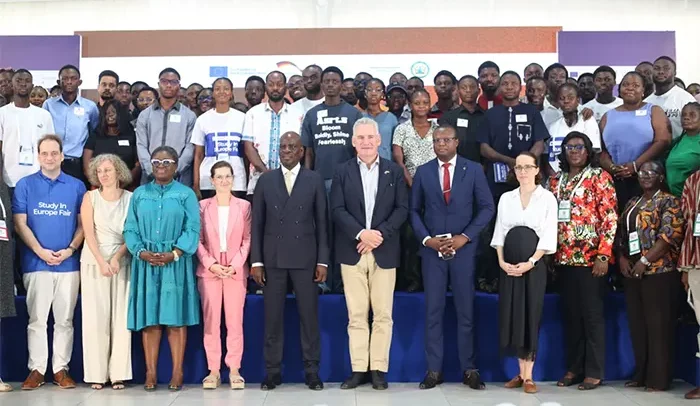
Rune Skinnbach (M), Haruna Iddrisu (5th left), officials and students in a group photograph at the 2026 Study in Europe Fair
Minister for Education, Haruna Iddrisu, has appealed to the European Union (EU) and its member states to adopt a more generous and accommodating approach when granting visas to Ghanaian students seeking higher education abroad.
Speaking at the 2026 Study in Europe Fair, where the EU and its member states are collaborating with tertiary universities in Ghana, the minister highlighted the importance of international academic exposure while reassuring partners of Ghanaian students’ commitment to returning home.
”We want opportunities to come back to serve Ghana and save the world,” Mr. Iddrisu stated, urging Team Europe to loosen rigid barriers while encouraging Ghanaian youth to seize global learning opportunities.
The 2026 study in Europe Fair was hosted at the University of Ghana (Legon), and was themed, “Discover, connect and go further.”
Addressing prospective applicants, Mr. Iddrisu cautioned students against taking eligibility criteria for granted or providing inaccurate information during visa applications. Citing a case where an applicant was denied a visa due to a single mismatch regarding family members residing abroad, the minister stressed that absolute honesty and thoroughness are non-negotiable. Minor inconsistencies, he warned, can permanently destroy life-changing opportunities.
To ensure fair access to international education, the minister highlighted the structural reforms following the passage of the Ghana Scholarship Authority Act (Act 1149), explaining that, the new legislative framework aims to end fragmented scholarship allocations by enforcing close collaboration between the Ghana Education Trust Fund (GETFund) and the newly established Scholarship Authority.
”Under this unified approach, financial support will be targeted strictly at deserving students and aligned with Ghana’s long-term national manpower needs, particularly in fast-evolving sectors such as Artificial Intelligence and digital health technologies,” he said.
He disclosed that, through joint degrees, double-degree programmes, and shared research hubs, students will be able to complete portions of their studies at local institutions, such as the University of Ghana, while completing key semesters or research phases at European partner universities.
”This model ensures access to advanced European laboratories, digital libraries, and global networks without severing ties with Ghana’s local innovation ecosystem,” he emphasised.
He thus charged the young scholars benefiting from international schemes such as Erasmus+, DAAD, and Chevening, to treat global platforms as a ladder to success, but remain committed to returning home.
The European Union Ambassador to Ghana, Rune Skinnebach, stated that, the 2026 study in Europe Fair, reflects the shared effort by the European Union and member states to bring study opportunities in Europe closer to young people in Ghana.
According to him, the fair brings together practical guidance and dialogue where participants can access exhibition space with booths presenting study opportunities, scholarships, and information on admission requirements. The programme also includes Erasmus+ presentations, a CV clinic, and a thematic session on how to prepare a successful application.
”Studying in Europe is about building skills, networks, and long-term connections between Ghana and Europe. The “Team Europe” approach brings together opportunities presented by Germany, France, Italy, and Austria, alongside Erasmus Plus, opening pathways across the wider European higher education space,” he said.
Deputy German Ambassador to Ghana, Sarah Pfaffernoschke, noted that, “Education is one of the most powerful investments we can make in individuals, societies, and the future of our countries, creating opportunities, building skills, and bringing cultures closer together.”
According to her, Germany is exceptionally proud of its longstanding educational relationship with Ghana, which dates back to Ghana’s independence in 1957.
She disclosed that, to ensure students do not have to navigate the process alone, “Study in Europe” desks have been established at 13 institutions across the country, supported by trained focal persons.
”My three simple pieces of advice for the scholars are to be curious and explore their options, prepare well by understanding eligibility criteria and deadlines early, and think beyond the classroom to how their acquired knowledge can shape their future and serve the community,” she urged.
”To all the students, graduates, and prospective scholars joining us today, this fair is dedicated to your ambitions, your aspirations, and the opportunities available to help you realise them,” she added.
By Janet Odei Amponsah