
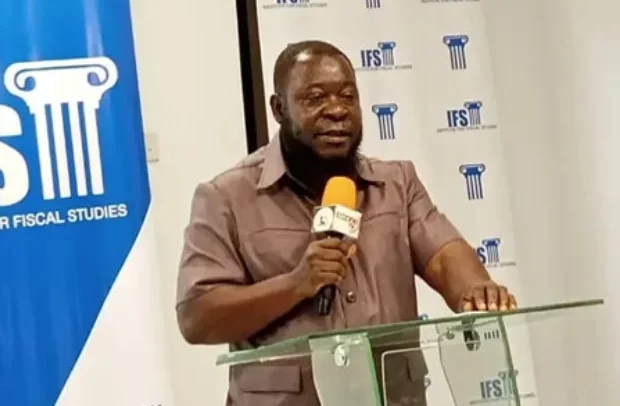
Dr. Said Boakye
The Institute For Fiscal Studies (IFS), has urged the government to invest more in the country’s extractive sector in order to increase revenue and bridge the gap between Ghana’s revenue performance and other African countries.
Executive Director IFS, Dr. Said Boakye made this known at a Press briefing yesterday in Accra ahead of the 2027 budget statement.
The proposed recommendation forms part of recommendations proposed by the Institute to strengthen domestic revenue mobilisation and increase the country’s revenue-to-GDP ratio.
According to the IFS, the average total revenue and grants-to-GDP ratio among a sample of 25 sub-Saharan African countries stands at 20.1 per cent, compared with Ghana’s 15.7 per cent which places Ghana 18th among the 25 countries, with its performance falling 4.4 percentage points below the regional average.
The institute further noted that Namibia, Seychelles and Botswana recorded revenue and grants-to-GDP ratios of 31.3 per cent, 30.0 per cent and 29.5 per cent, respectively.
The figures he added exceeded Ghana’s ratio by 15.6, 14.3 and 13.8 percentage points stating that Ghana’s relatively low revenue-to-GDP ratio meant the government was collecting substantially less revenue than its economic potential could generate.
For instance, it estimated that Ghana collected GH¢96.65 billion in total revenue and grants in 2022, equivalent to US$11.68 billion and representing 15.7 per cent of GDP.
He, however, added that if the country had achieved the sub-Saharan African average of 20.1%, total revenue and grants would have increased to GH¢123.48 billion, equivalent to US$14.93 billion which would have represented an additional US$3.25 billion in revenue and grants.
According to the Executive Director, the government should partner private investors, follow the example of Botswana and scale down its traditional public investment programmes, such as in infrastructure, for a while and direct the funds involved to the extractive sector.
Dr. Boakye explained that such investments could generate additional resources and enable the government to improve public investment in traditional areas in the future.
He, however, stated that the government could adopt production-sharing agreements if it faces difficulties in raising the required capital.
He said such alternative arrangements has proven to be better in the extractive sector than the existing arrangement the country has
IFS also called on the government to intensify the fight against corruption, particularly within tax and non-tax revenue collection agencies, while adopting a combination of incentives and sanctions to improve revenue mobilisation.
Dr. Said noted that although adopting an appropriate revenue-generation regime in the extractive sector could significantly increase total revenue and grants, the gains alone would not be sufficient to raise the country’s revenue-to-GDP ratio to the levels recorded by some of its African peers.
The institute also recommended a review of existing tax exemptions and incentives stating that excessive reliance on tax concessions as a means of attracting investment may not always be helpful to the country.
The Executive Director indicated that such a review should consider the revenue losses associated with the exemptions against their contribution to employment creation for Ghanaians and foreign exchange inflows that help support the cedi.
By Ebenezer K. Amponsah