
President John Maham
President John Mahama has described the new Ghana Cedi Heritage Series notes as celebrating the country’s rich history, cultural identity and national unity while strengthening citizens’ appreciation of the currency.
President John Mahama has described the new Ghana Cedi Heritage Series notes as a symbol of national pride, shared heritage and unity.
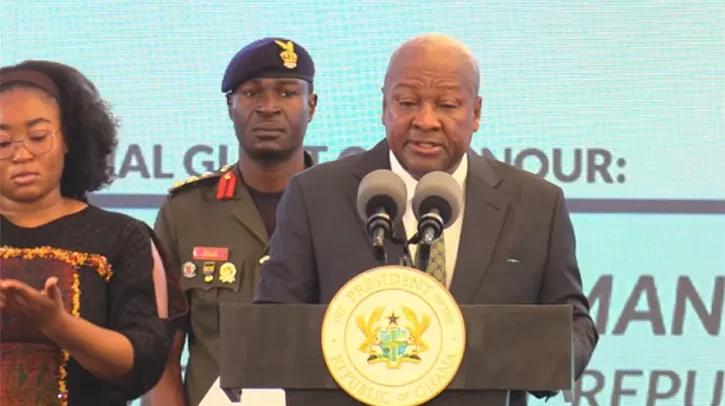
Speaking at the official launch at the Bank Square in Accra, President Mahama said the notes does not only serve as a medium of exchange but also carried the country’s history into the daily lives of its people as well as reflects the country’s confidence in its collective future.
He commended the Governor, Management and staff of the Bank of Ghana, as well as international partners, for their contributions towards making the initiative a reality.
The President who traced the origin of the Cedi to the Akan word for cowry shell, recounted how cowries were used as a medium of exchange by the coubtry’s forebears before the establishment of modern financial institutions.
He noted that cowries facilitated trade among communities across the savannah, forest and coastal areas, while gold dust, measured with carefully crafted brass weights, also played an important role in the country’s traditional trading system.
Using the image of two crocodiles sharing one stomach, a familiar symbol represented in traditional brass weights, President Mahama also highlighted the importance of cooperation and shared responsibility stating that the symbol remained relevant to modern Ghana as the decisions of individuals and institutions have consequences for the wider society.
The President explained that the currency connects Ghanaians across all regions, religions and political affiliations, making it a powerful symbol of national belonging.
President Mahama further described the Cedi as a quiet ambassador for Ghana, noting that it could be one of the first means through which international visitors encounter the country’s history and culture.
He said the new notes would also help projects the country’s history closer to younger generations by featuring national figures, historic places and cultural symbols that could encourage learning and deepen understanding of the history of the country.
The President expressed gratitude to individuals whose contributions and sacrifices had helped shape the country while urging young people to draw inspiration from their achievements and play an active role in building the country’s future.
On the technical features of the new currency, President Mahama disclosed that the notes were produced using reinforced cotton paper designed to last longer than the existing banknotes.
He added that the new notes were also smaller and easier to handle stating that the new series would circulate alongside the existing notes, which would be gradually withdrawn by banks until the new currency fully replaces them.
Touching on the economy, President Mahama said the Cedi had endured difficult economic periods but remained an important expression of the country’s economic sovereignty.
He stressed that strengthening the currency required building a more productive and resilient economy associating the initiative to the government’s $10 billion, four-year New Economy Programme, which seeks to transform the structure of the Ghanaian economy by increasing domestic production, processing more locally grown commodities and expanding exports.
President Mahama explained that producing more goods locally would create employment, reduce dependence on imports and limit the country’s demand for foreign exchange adding that expanding, diversifying exports and disciplined public financial management and credible monetary policies, would help create the conditions for a stronger and more stable Cedi.
While expressing confidence in the future of the currency, the President noted that the strength of the cedi will translate into greater certainty for traders, manufacturers, families and businesses.
He also commended the Bank of Ghana for developing local expertise and systems to support its currency operations as the institution approaches 70 years of service.
He urged the Bank to continue investing in Ghanaian professionals and institutional capacity to strengthen the country’s economic independence while calling on Ghanaians to take pride in the new Heritage Series Bank notes and protect the unity and confidence that the national currency represents.
By Ebenezer K. Amponsah