
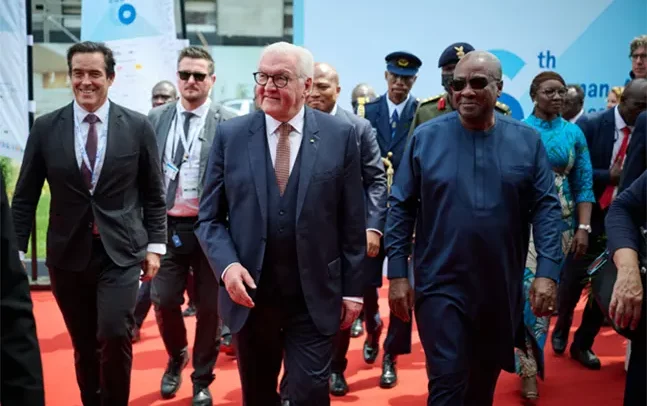
President John Dramani Mahama with German President, Frank-Walter Steinmeier, Diplomats and business executives
President John Mahama says Africa and Germany must focus on a new partnership that will boost investment, trade and technology transfer rather than relying on development assistance.
Addressing participants at the 6th German – African Business Summit (GABS 2026) in Accra, President Mahama said changing global economic conditions presented an opportunity for Africa to reposition itself as a competitive destination for investment, manufacturing, innovation and sustainable industrial development.
“It marks an important moment to redefine the terms of our economic engagement between Africa and Germany, shifting from traditional donor dependence to trade, investment, industrial cooperation, technology transfer, value addition and shared prosperity,” he said.
“We must process what we produce, we must manufacture what we consume, and compete effectively in regional and global markets,” he said.
President Mahama also urged German businesses to see Africa as an interconnected investment and production market rather than a collection of isolated national economies, citing the African Continental Free Trade Area (AfCFTA) as a major opportunity for expanding trade and investment across the continent.
He said the AfCFTA, which has its secretariat in Accra, provides access to a continental market of approximately 1.4 billion people, with a combined GDP of more than US$3.5 trillion.
The President also encouraged German companies to consider Ghana as a strategic entry point into the African market, highlighting the country’s economic recovery, improved macroeconomic indicators and ongoing reforms to create a more attractive business environment.
He further said agriculture, agro-processing, manufacturing, energy, infrastructure, pharmaceuticals, tourism, digital innovation and mineral beneficiation were some of the key sectors offering investment opportunities for German companies.
According to him, Ghana plans to invest US$10 billion between 2027 and 2030 in its New Economy Programme, with implementation expected to involve partnerships with the private sector, including German businesses.
President Mahama stressed that the success of the renewed economic relationship would depend on practical investment partnerships, technology transfer, stronger local supply chains and the establishment of manufacturing enterprises.
He cited the North Shore Apparel factory in the Northern Region as an example of the impact of German-backed investment, noting that financing from Germany’s KfW, alongside support from Ghana’s Exim Bank, had helped establish a factory employing more than 2,000 young people, 80 per cent of whom are women.
He said the investment demonstrated how international partnerships could create employment opportunities and support economic development in local communities.
The President also called for stronger engagements, investment matchmaking and project development between Ghanaian and German companies, emphasising that the success of the summit should be measured by the partnerships and investments secured after the event.
He further reaffirmed the country’s commitment to building a transparent, competitive and predictable business environment to attract investments and deepen economic cooperation with Germany.
President Mahama added that the future of German-African relations should be defined by partnerships that combine the strengths of both regions to increase industrialisation, strengthen competitiveness and deliver lasting economic benefits to their people.
By Ebenezer K. Amponsah