
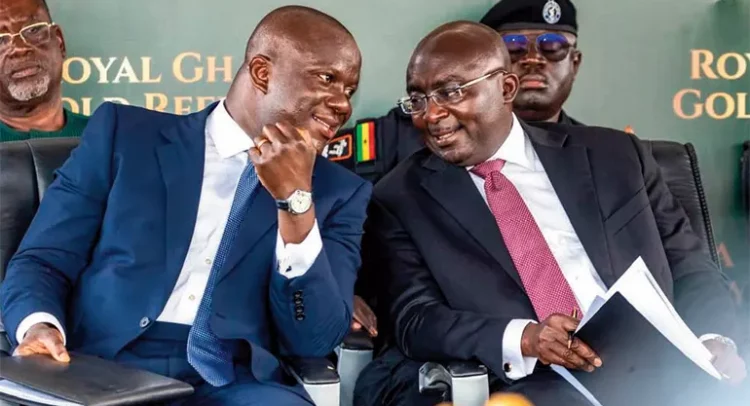
Dr. Mahamudu Bawumia with Abu Jinapor (L)
Recent comments by the Flagbearer of the New Patriotic Party (NPP) on the Domestic Gold Purchase Programme while addressing the Ghana National Association of Small Scale Miners have generated some discussions. As the then Minister responsible for Mines at the time the programme was introduced, I deem it necessary to set the records straight as follows.
- The Domestic Gold Purchase Programme is the brainchild of H.E. Dr. Mahamudu Bawumia, conceived at a time when the country was facing severe economic challenges as a fallout from the twin crisis of the COVID-19 pandemic and the Russian – Ukraine war. As head of the Economic Management Team, he conceived the idea, held strategic meetings with relevant stakeholders, and instructed the Ministry of Lands and Natural Resources (the Ministry), to engage all stakeholders under the Ministry, before the Programme was formally launched on 17th June 2021 at the then head office of the Bank of Ghana.
- This was the first time the Government of Ghana was purchasing gold domestically to shore up gold reserves and augment foreign reserves. When Government decided to boost the country’s gold reserves in 1960, they purchased gold from abroad and transported it to the Bank of Ghana’s vault. Under this innovative Programme, however, the Bank of Ghana purchased gold locally from licensed aggregators and mining companies, and paid them in the Ghana Cedis equivalent of the prevailing market price.
As the then Governor of the Bank of Ghana rightly observed in his remarks at the launch of the Programme, “This event is indeed historic as it marks the first time the Bank of Ghana is embarking on a domestic gold purchasing to augment our foreign reserves with a view to doubling Gold holdings in our foreign exchange reserves portfolio. It therefore marks a significant change in the modus operandi of Bank of Ghana’s foreign exchange reserves management operations.”
- At the time of the launch of the Programme, Ghana’s gold reserve stood at 8.77 tonnes, and had been so for a very long time. And even though the Bank of Ghana’s target was to double this figure in five (5) years, as at December 2024, less than four (4) years into the implementation of this consequential Programme, the Bank of Ghana had almost quadrupled their reserves, from 8.77 tonnes to 30.53 tonnes.
- In furtherance of the objectives of this programme, the Ministry held series of meetings with the Ghana Chamber of Mines and the Ghana National Association of Small Scale Miners, and after extensive deliberations, on 23rd November, 2023, the Ministry invoked the Government’s pre-emptory right under section 7 of the Minerals and Mining Act, 2006 (Act 703), and issued policy directives to the Minerals Commission and the erstwhile Precious Minerals Marketing Company (PMMC), which was later amended on 4th January, 2024, to give effect to the Policy.
- Under these Directives, which is a matter of public record, all large scale mining companies were required to sell twenty percent (20%) of their refined gold to the Bank of Ghana in Ghana Cedis before exporting the rest, and all Community Mining Schemes as well as all Licensed Small Scale Miners were to sell all their gold to Government through the PMMC. All small scale and community mining licences were to have a clause mandating them to sell their gold output to Government. These Directives received wide publication, not only in Ghana, but in the international media, as reported by Reuters.
We emphasised on Licensed and responsible Small Scale Miners because we didn’t want to have anything to do with illegally sourced gold, and the Directives were coordinated and enforced by the Minerals Commission, the PMMC and the Bank of Ghana with support from the Ghana Chamber of Mines and the Ghana National Association of Small Scale Miners.
To further ensure compliance, on 3rd May 2023, the Ministry issued further directives to the Minerals Commission and the PMMC, not to process any application for a gold export licence without the express written approval of the Minister. Despite all these measures, gold exports reached a record 11.6billion US Dollars (US$11,600,000,000.00) in 2024, up from 7.6 billion in 2023 and 6.6 billion in 2022.
- It is important to emphasize the unimpeachable fact that, it is these reserves accumulated under the Domestic Gold Purchase Programme that has been the backbone of our National economy to date. Indeed, at the 77th Annual New Year School and Conference held at the University of Ghana on 6th January 2026, the Governor of the Bank of Ghana, Dr. Johnson Asiama, said the Domestic Gold Purchase Programme has strengthened external buffers and macroeconomic stability, noting that the Programme has been crucial to the stabilisation goal of the Bank of Ghana.
This Government’s “Ghana Accelerated National Reserve Accumulation policy (GANARAP),” is nothing more than a renaming of the Domestic Gold Purchase Programme. It is also a fact that this renamed policy has resulted in the sale of more than half of the gold accumulated by the Akufo-Addo/Bawumia Government under the Domestic Gold Purchase Programme.
- Let the public record of our country reflect that the Domestic Gold Purchase Programme which has resulted in the exponential increase of the reserves of the Central Bank of our country and contributed significantly to our national economy was the brainchild of H.E Dr. Mahamadu Bawumia.