
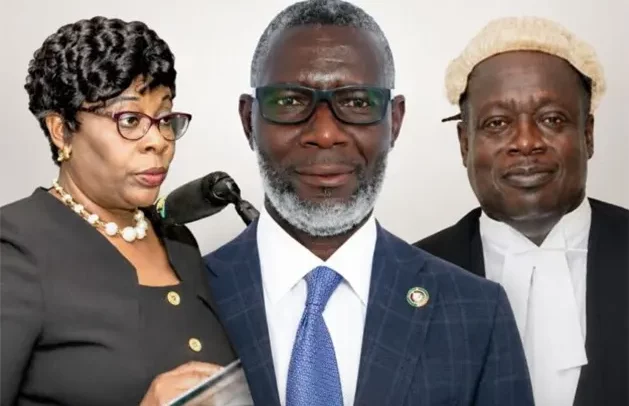
Justice Sophia Rosetta Bernasko Essah, Justice Edward Amoako Asante and Anthony Forson Jnr.
The Appointments Committee of Parliament has unanimously recommended the approval of three nominees for appointment to the Supreme Court (SC), following a dramatic walkout by members of the Minority Caucus during the vetting process.
The nominees are Justice Sophia Rosetta Bernasko Essah, Justice Edward Amoako Asante and private legal practitioner, Anthony Forson Jnr.
Despite the disruption that characterised portions of the vetting, members of the Majority on the Committee reached a unanimous decision to recommend all three nominees for approval by the House.
The Committee is expected to present its report to Parliament for consideration and approval by plenary.
If approved by Parliament, the appointments will increase the number of Justices of the Supreme Court from the current 18 to 21.
Minority Boycotts Vetting
Meanwhile, the Minority in Parliament yesterday boycotted the vetting of three Supreme Court nominees after raising strong objections to what it described as breaches of parliamentary procedure and constitutional safeguards.
The Minority Leader, Alexander Afenyo-Markin, urged the Appointments Committee to suspend the exercise and allow at least 14 days for the public to scrutinise the nominees and submit memoranda on their suitability for appointment.
However, the Chairman of the Committee, Bernard Ahiafor, dismissed the Minority’s objection as “flimsy and hollow”, insisting that the House had already taken a decision to waive the relevant Standing Orders to enable the committee to deal urgently with the matters for which Parliament was recalled.
The three nominees are Justice Sophia Bernasko-Essah, Justice Amoako Asante and former Ghana Bar Association (GBA) President, Anthony Forson Jnr.
The Minority Leader said the decision to proceed with the vetting violated Standing Order 217(10), which required the publication of nominees’ names in newspapers of national circulation to invite memoranda and representations from the public.
He argued that publication without sufficient time for citizens, the legal profession and civil society organisations to examine the backgrounds of the nominees defeated the purpose of the provision.
“As you requested back then, when you were in opposition. Let’s allow 14 days,” Mr. Afenyo-Markin said, urging the committee to suspend the process.
He said the 14-day period would not prejudice the appointment process, particularly as the Supreme Court was on vacation.
According to him, the committee could receive memoranda, complete its report and submit it to Parliament before the House resumed in October, thereby allowing the nominees to be considered ahead of the new legal year.
Mr. Afenyo-Markin also challenged the interpretation of Standing Order 217(11), which requires a committee to report to Parliament within three days after the conclusion of its proceedings.
He argued that the provision did not require the committee to complete the vetting itself within three days of the referral or within the period of the parliamentary recall.
He further raised concerns about the composition of the committee under Standing Order 217(2) and (3), arguing that the requirements for co-opting members from the relevant subject-matter committee could not be properly fulfilled for three separate judicial nominations within the compressed timetable.
The Minority Leader also maintained that no substantive motion had been moved on the floor of Parliament to suspend the relevant Standing Orders.
He said the adoption of the Business Committee’s report could not, by itself, override express provisions of the Standing Orders requiring a motion, debate and decision of the House before such rules could be suspended.
“Never on the House floor have we had such a precedent where a Business Committee’s report was used to override express provisions of Standing Orders,” he said.
Mr. Afenyo-Markin further called for confirmation that the constitutional requirements under Article 144(2) had been met before the nominees were vetted.
He said the committee ought to establish that the President had obtained the advice of the Judicial Council and consulted the Council of State before proceeding with the nominations.
He also invoked Article 296 of the Constitution, arguing that discretionary powers relating to the scheduling of parliamentary business had to be exercised fairly, candidly and without arbitrariness.
According to him, there was no demonstrated urgency requiring the vetting to be completed within the limited period, particularly because there was no immediate vacancy on the Supreme Court.
He described the decision to compress the process as politically convenient and warned that the Majority’s numerical strength should not be used to “stampede” the proceedings.
The Minority Leader said the consequences of procedural errors in appointing Supreme Court justices were particularly serious because Parliament’s approval represented one of the final substantive checks on a nominee before appointment.
He stressed that the Minority was not opposed to the nominees themselves but was demanding that the process be conducted in accordance with the law and Parliament’s own rules.
Ahiafor’s Rebuttal
Responding to the Minority’s objections, Chairman of the Appointments Committee, Bernard Ahiafor, said the arguments had no basis in the circumstances surrounding the recall of Parliament.
He said President John Dramani Mahama’s letter dated August 11, 2026, requesting the recall of Parliament clearly identified three categories of business, including the referral, vetting and consideration of the three Supreme Court nominees.
The other matters were the Banks and Specialised Deposit-Taking Institutions Act Amendment Bill, 2026, and two nominations for appointment as ministers of state.
Mr. Ahiafor said Parliament had subsequently been recalled from Monday, August 24 to Friday, August 28, 2026, specifically to deal with those matters.
He said the Appointments Committee had also met the previous day and considered the issue of whether the three judicial nominees could be vetted without a separate publication period.
According to him, the committee had decided that it could not discriminate between the ministerial nominees and the judicial nominees because all five nominations formed part of the President’s request for the recall.
He further argued that the House had already dealt with the question of suspending the relevant Standing Orders when it adopted the Business Committee’s report.
Mr. Ahiafor cited proceedings in Parliament indicating that the Majority Chief Whip, Rockson-Nelson Etse Kwami Dafeamekpor, had sought a waiver of Standing Order 217 to facilitate the urgent consideration of the President’s requests.
He said Speaker Alban Bagbin had ruled that because the request for the waiver formed part of the Business Committee’s report and the House subsequently adopted the report, there was no need for a separate motion.
“Once the House has adopted the Business Committee’s report, it means that the House has taken a decision to waive Standing Order 217 for the committee to consider these matters as a matter of urgency,” he said.
Mr. Ahiafor maintained that the committee could not overturn a decision already taken by the full House.
“If the House takes a decision, no committee can vary the decision of the House,” he said.
He consequently rejected the Minority’s demand to suspend the vetting, saying he would not preside over a process that treated the ministerial nominees differently from the Supreme Court nominees.
“I will not preside over this particular committee and discriminate against the judges, allow the vetting of our colleagues, and then reject the vetting of the judges’ nominees. I will not do that today. I won’t do that tomorrow,” he said.
Mr. Ahiafor described the Minority Leader’s objections as “flimsy and hollow”, and said he had dismissed them at the outset because they were, in his assessment, unsupported by the facts, rules and law.
The dispute subsequently led to the Minority’s decision not to participate in the vetting of the three Supreme Court nominees.
By Ernest Kofi Adu, Parliament House