
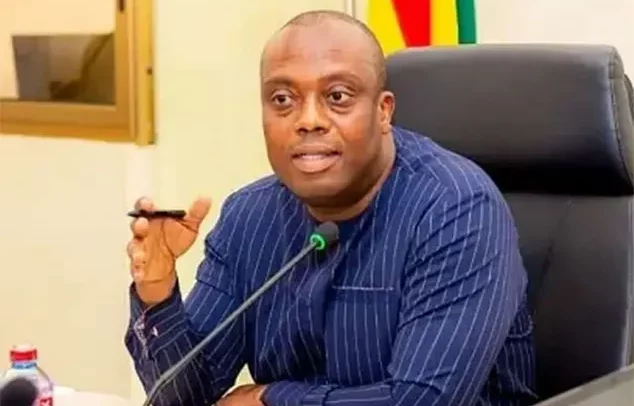
Thomas Nyarko Ampem
Artisanal and small-scale miners have emerged as the backbone of the nation’s gold aggregation programme, supplying about 99.5 percent of all gold purchased by the Ghana Gold Board (GoldBod) since its establishment, Deputy Finance Minister, Thomas Nyarko Ampem, has disclosed.
Answering questions in Parliament yesterday, Mr. Ampem said GoldBod purchased a total of 135.843 metric tonnes of gold between January 2025 and May 2026, with 135.221 metric tonnes originating from the artisanal and small-scale mining (ASM) sector.
According to him, the figures underscore the dominant role played by small-scale miners in supporting the government’s efforts to mobilise foreign exchange, strengthen reserves and curb gold smuggling.
The Deputy Minister described GoldBod as a strategic pillar of the country’s macroeconomic recovery programme, saying it was established to formalise the gold trade, improve transparency and ensure that the country captures greater value from its mineral resources.
“The Ghana Gold Board is a strategic arm of our nation’s macroeconomic recovery, anchored on foreign exchange mobilisation and anti-smuggling architecture,” he told the House.
He indicated that the enactment of the Ghana Gold Board Act, 2025 (Act 1140), was aimed at bringing gold trading activities into the formal economy and addressing long-standing challenges associated with smuggling and fragmented trading channels.
Mr. Ampem cited reports indicating that the nation lost an estimated US$11.4 billion through gold smuggling between 2019 and 2023, stressing that GoldBod was helping to reverse the trend.
To support its operations, he said GoldBod has established a nationwide network of licensed buyers who purchase gold from licensed miners for onward sale to the Board.
As of May 31, 2026, a total of 1,184 buyers had been licensed under the GoldBod regime, comprising two aggregators, 67 self-financing aggregators, 736 Tier Two buyers and 379 Tier One buyers.
The Deputy Minister noted that all licensed buyers are required to purchase gold exclusively from licensed miners, a measure designed to enhance traceability and accountability within the gold supply chain.
He further revealed that GoldBod purchased, aggregated and exported 104 metric tonnes of ASM gold in 2025 alone, generating more than US$10 billion in revenue for the country.
According to him, the performance of the Board contributed significantly to the appreciation of the cedi by about 41 percent in 2025 and helped increase the nation’s gross international reserves from approximately US$8.98 billion in December 2024 to US$13.8 billion by the end of 2025.
Mr. Ampem said GoldBod spent about US$16.1 billion on gold purchases between January 2025 and May 2026, with US$9.8 billion of that amount expended during the 2025 calendar year.
He said the government’s broader objective was to move the nation away from a system in which gold wealth was underpriced, dispersed and vulnerable to smuggling.
“Through GoldBod, we have a regime where gold is transparently aggregated, assayed, refined, exported and turned into foreign exchange and reserves for the Republic with visible and tangible benefits for the entire country,” he stated.
The Deputy Minister also disclosed that GoldBod has strengthened collaboration with the National Anti-Illegal Mining Operations Secretariat (NAIMOS) to improve regulatory compliance and support efforts to combat illegal mining.
He stressed that GoldBod’s mandate extends beyond gold purchasing, describing the institution as a vehicle for enhancing Ghana’s economic sovereignty through the strategic management of the country’s gold resources.
“GoldBod is not just about buying gold. It is about capturing Ghana’s gold for Ghana’s balance sheet, Ghana’s reserves and Ghana’s economic sovereignty,” he said.
By Ernest Kofi Adu, Parliament House