
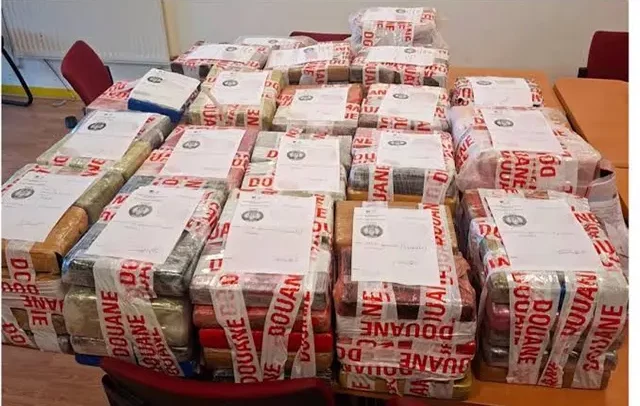
The intercepted cocaine
The Narcotics Control Commission (NACOC) has arrested three suspects allegedly linked to the activities of Dutch fugitive Jos Leijdekkers, popularly known as “Bolle Jos”, in Ghana.
According to NACOC, the suspects allegedly represented and facilitated the activities of Leijdekkers, who is wanted in connection with international drug trafficking.
The arrests followed the reported seizure by French customs of a cocaine shipment allegedly linked to a wider drug-trafficking network.
In a statement issued yesterday and signed by Francis Opoku Amoah, Ag. Director of Public Affairs & International Relations, NACOC said the three suspects were in its custody and assisting investigators to establish their alleged roles in the trafficking activities.
The Commission said the arrests formed part of its efforts to disrupt international drug-trafficking organisations operating in or through the country.
It reaffirmed its resolve to ensure that Ghana did not become a safe haven, transit point or operational base for international drug-trafficking organisations.
NACOC said it would continue working with domestic and international law-enforcement partners to disrupt the people, finances and infrastructure sustaining the illicit drug trade.
The Commission, however, stressed that the rights and legal protections of all persons under investigation would be safeguarded.
NACOC said investigations into the three suspects were ongoing.
Minority Demands Probe
Meanwhile, the Minority in Parliament has called for an independent parliamentary inquiry into a series of major narcotics seizures linked to Ghana, accusing the National Democratic Congress (NDC) government of allowing the country to become a transit hub for international drug trafficking.
The Minority said the seizures, recorded locally and abroad over the past 18 months, involved narcotics worth more than US$1 billion and raised serious questions about the effectiveness of the country’s security and law enforcement agencies.
In a statement signed by the Ranking Member on the Defence and Interior Committee, Rev. John Ntim Fordjour, the Minority said the government must account for what it described as Ghana’s increasing involvement in international narcotics trafficking.
It cited the seizure of more than 3.3 tonnes of cocaine concealed beneath sand in a tipper truck at Pedu Junction in Cape Coast on March 4, 2025.
According to the statement, the consignment, which was travelling from Takoradi to Accra, had an estimated street value of more than US$350 million.
The Minority also referred to the interception of about 120 slabs of cocaine, estimated at US$150 million, along the Takoradi-Cape Coast highway during the same period.
It further cited the seizure by the Tema Regional Police Command on August 5, 2026 of 866 parcels of suspected cocaine concealed in sacks of gari at a warehouse within the Tema Harbour enclave. The consignment was valued at about US$6.9 million.
The Minority said two other incidents remained unresolved, including the alleged landing at the Kotoka International Airport around March 20, 2025 of an aircraft suspected of carrying narcotics and undeclared United States currency from Gran Canaria.
It also raised questions about the July 2025 MV Sankofa incident, in which a vessel allegedly sailing under a forged flag and facing a fine of nearly GH¢12 million was released by the Ghana Maritime Authority after payment of only a fraction of the amount.
The Minority said the vessel was released without a full inspection of its cargo but was arrested days later in Senegal carrying narcotics.
It said the nation’s involvement in international narcotics cases had also become evident through seizures in other countries.
The statement noted that Australian customs authorities seized 320kg of methamphetamine worth about US$261 million on June 18, 2026, concealed in a charcoal consignment traced to Ghana.
It also cited a Reuters report that French customs officers at the port of Dunkirk seized nearly 3.9 tonnes of cocaine, valued at more than US$260 million, concealed in a container of plastic waste that had departed Ghana.
The Minority expressed concern that despite the scale of the seizures, investigations appeared to have focused largely on couriers and other low-level suspects.
It specifically questioned why, more than a year after the Pedu Junction seizure, only the driver, a housemaid and a few other peripheral suspects had been arraigned and remanded on bail.
The Minority said the financiers and major dealers behind the US$350 million cocaine consignment remained unidentified and unpunished.
“This pattern – in which couriers, drivers, mates, and freight-forwarding agents are paraded before the courts while the true owners of these consignments walk free – raises serious questions about the seriousness, independence, and reach of investigations under this Government,” it said.
It demanded a full-scale independent parliamentary inquiry into the possible complicity, negligence or failure of oversight involving the Ministry of Interior, Ministry of Transport, Narcotics Control Commission, Ghana Ports and Harbours Authority, Ghana Immigration Service and the Bureau of National Intelligence.
The Minority wants the relevant sector ministers and heads of the agencies summoned before Parliament to account for the status of investigations into all the seizures and explain why prosecutions had allegedly targeted mainly low-level actors.
It also wants Parliament to establish the circumstances surrounding the release of the MV Sankofa, including who authorised the reduced fine and the decision to allow the vessel to sail without a full cargo inspection.
The Minority further demanded an account of measures being taken to protect Ghana’s ports, airports and territorial waters from exploitation by international drug cartels.
By Ernest Kofi Adu