
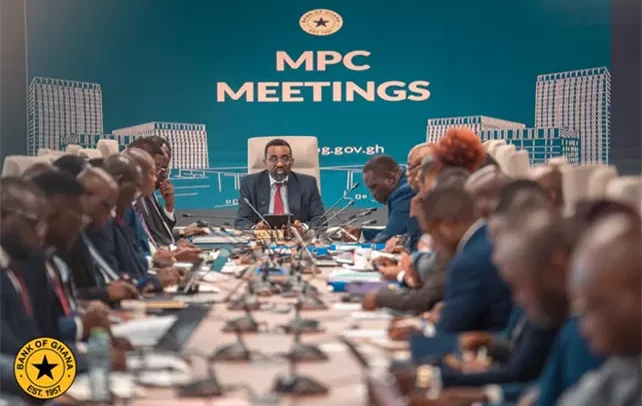
Members of the Monetary Policy Committee
The Bank of Ghana (BoG) says the country’s economy continues to demonstrate resilience, with inflation remaining in single digits and below the medium-term target band, strong economic activity and external sector surpluses, despite persistent uncertainties in the global economy.
Speaking at the opening of the 133rd Monetary Policy Committee (MPC) meeting in Accra on Monday, the Governor of BoG, Dr. Johnson Asiama, said the macroeconomic stabilisation process remained broadly on track.
He attributed the progress to disciplined policy implementation, effective liquidity management and reforms in foreign exchange operations and reserve management.
“The macroeconomic stabilisation process remains broadly on track. Inflation remains in single digits and below the medium-term target band, economic activity has remained strong, and the external sector continues to record substantial surpluses,” he stated.
The central bank, however, cautioned that the country must remain vigilant in the face of emerging economic risks, despite the gains made through credible policy implementation and reforms.
“We cannot afford to be complacent. We remain conscious of the risks to the inflation outlook and the need to strengthen the economy’s resilience while responding appropriately as these risks evolve,” he added.
Dr. Asiama said the Committee had identified geopolitical tensions, supply chain disruptions and adverse weather conditions, particularly the possibility of an unusually strong El Niño episode, as external developments that could affect global commodity prices, domestic food production, cocoa output and export earnings.
He noted that these developments could have implications for inflation and exchange rate stability, requiring a comprehensive assessment of their potential impact on the domestic economy.
On the domestic front, the Committee observed that headline inflation had increased marginally from 5.2 percent in September to 5.5 percent in October 2026, although it remained below the medium-term target band.
The Bank also identified the external sector as a major source of economic strength, with the Committee emphasising the need to assess the sustainability of the current account surplus, foreign exchange inflows and the extent to which export earnings translate into sustained reserve accumulation.
On fiscal policy, the Committee said the 2027 Budget would be critical in determining the interaction between government spending and monetary policy, particularly its implications for aggregate demand, liquidity, inflation and the exchange rate.
It stressed the need for fiscal and monetary policy frameworks to remain coherent and mutually reinforcing to preserve macroeconomic stability.
Dr. Asiama said as the Committee concluded its policy deliberations for the year, it was important to preserve the gains made in restoring price stability and exchange rate confidence while supporting sustainable economic activity.
“As we conclude the year’s policy deliberations, we must ensure that our decisions preserve the gains achieved in restoring price stability and exchange-rate confidence, while supporting sustainable economic activity. Policy decisions must remain forward-looking, recognising that choices made at the final meeting would shape the economic conditions under which Ghana enters 2027,” he added.
By Ebenezer K. Amponsah