
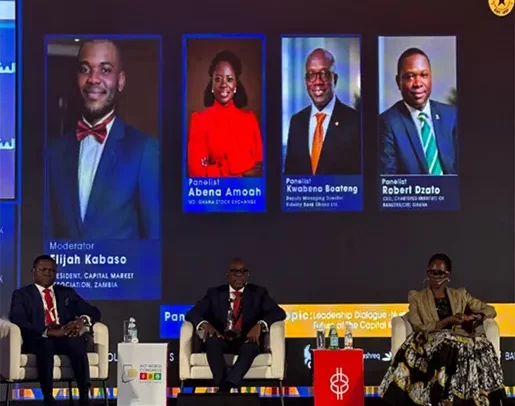
Panelists at the event
The Deputy Managing Director for Wholesale Banking at Fidelity Bank Ghana, Kwabena Boateng, has urged financial institutions to elevate leadership development from a routine human resource activity to a strategic boardroom priority, warning that the future of the country’s capital markets depends on how organisations prepare their next generation of leaders.
Speaking at the Leadership Dialogue on “Nurturing the Future of Capital Markets” during the ACI World Congress in Accra, Mr. Boateng said institutions must deliberately identify, train and invest in young talent if they hope to remain competitive and sustainable in the long term.
Drawing from Fidelity Bank’s internal talent development strategy, he said leadership grooming must begin early and be supported by structured systems capable of identifying high-potential individuals and equipping them with the right skills.
“If you do not do the right sourcing, putting them through the needed training, you will not get what you want. It should come from the top. It should come from the boardroom. We should all be invited and ensure that these young people are trained and we extract the best out of them,” he said.
Mr. Boateng outlined two major initiatives being used by Fidelity Bank to build leadership capacity from within the institution.
According to him, the first is the Orange Talent Programme, targeted at high-performing employees already within the organisation. Participants undergo rigorous selection processes and are exposed to cross-functional training across different departments of the bank to broaden their experience and leadership capabilities.
The second initiative is the Graduate Training Programme, which recruits fresh university graduates and develops them through structured training and mentorship designed to build long-term professional capacity.
Mr. Boateng explained that mentorship within the bank is intentionally structured to ensure that direct supervisors do not serve as mentors to junior staff, allowing the mentorship relationship to remain developmental rather than managerial.
He stressed that mentorship goes beyond technical guidance and should involve the transfer of personal experiences, values and lessons learned over time.
“Mentorship is an experienced person sharing what they know; their thought processes, not only just the work, but also their daily life, their experiences, their failures,” he said.
He further highlighted the importance of exposing young professionals to unfamiliar working environments through secondments and structured attachments across different sectors, arguing that such experiences often produce deeper learning outcomes.
For Mr. Boateng, one of the biggest threats to institutional growth is the tendency for organisations to build leadership pipelines filled with individuals who think exactly like current managers.
“If as managers or leaders we expect to have the same leadership pipeline thinking like us, then what we have done is form a replica of ourselves. And that is very dangerous,” he cautioned.
“The wisdom or knowledge does not rest in one vessel. It rests in numerous vessels. And when we come together with different opinions and we converge, it is to the wider good and development of the organisation,” he added.
He also challenged corporate institutions to commit significant resources to leadership development in the same way they invest in infrastructure, technology and expansion projects.
A Business Desk Report